
Hey there! Some links on this page may be affiliate links which means that, if you choose to make a purchase, I may earn a commission at no extra cost to you. I greatly appreciate your support. Read the full disclosure here.
Every year, hundreds of people die from cold exposure after becoming stranded in vehicles during winter storms — not because rescue was impossible, but because they didn’t know what to do in the hours before help arrived. Knowing how to keep warm in cold car during a winter emergency is one of the most practical, potentially life-saving skills any prepared person can have. The good news: with the right gear pre-staged in your vehicle and a clear action plan, surviving a cold-weather stranding is very achievable.
Key Takeaways
- A car’s insulated cabin retains body heat surprisingly well — but only if you know how to maximize it.
- A healthy adult can survive several hours to a few days in a stranded vehicle, depending on temperature, wind chill, and available insulation.
- The single most important prep step is building a dedicated winter car emergency kit before you need it.
- Running your engine for heat is sometimes appropriate — but it carries a real carbon monoxide risk that kills people every winter.
- Emergency Mylar blankets, wool layers, hand warmers, and window insulation are your core thermal tools.
- Hypothermia can set in faster than most people expect — recognizing early signs is critical.
- Food and water in your car kit directly affect how long your body can maintain core temperature.
- Staying with your vehicle (rather than walking out) is almost always the right call.
What Supplies Do I Need to Stay Warm in a Stranded Car?
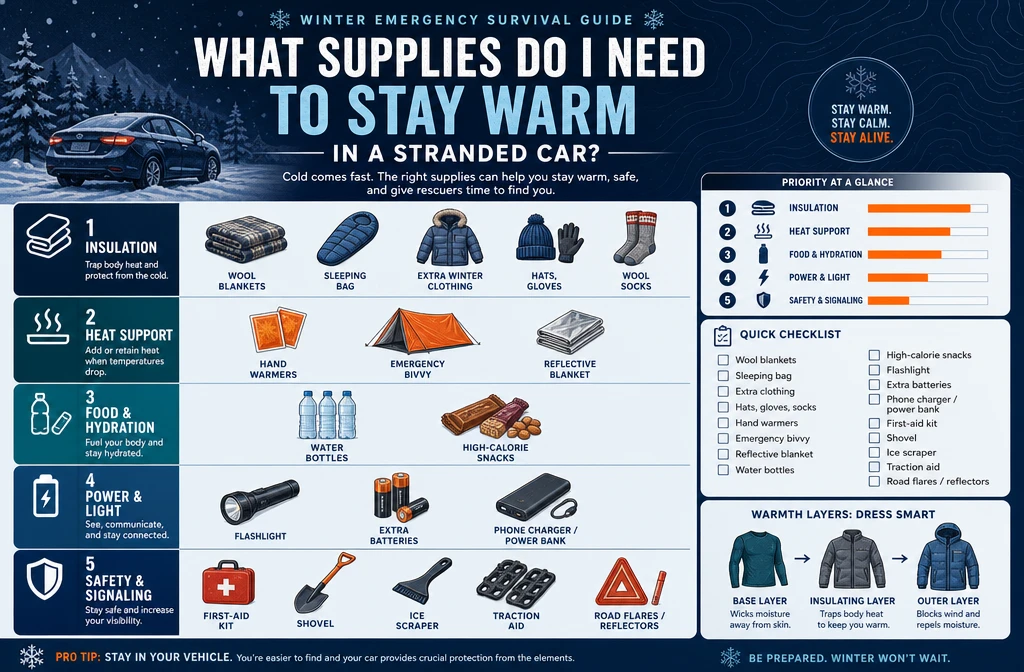
The right supplies, pre-packed in your vehicle, are what separate a dangerous situation from a manageable one. A dedicated winter car survival kit should cover insulation, signaling, nutrition, and basic first aid.
Core thermal supplies:
- Emergency Mylar space blankets (at minimum 2 per person) — these reflect up to 90% of body heat back toward you
- Wool or synthetic fleece blanket — wool retains warmth even when damp, unlike cotton
- Chemical hand warmers (HeatMax, HotHands, or similar) — 10–20 hours of heat per pack
- Warm hat, gloves, and wool socks — stored in the kit, not just what you’re wearing
- Sleeping bag rated to 0°F — if space allows, this is the single best thermal upgrade
Additional critical items:
- LED flashlight with extra batteries
- Road flares or LED emergency triangles
- High-visibility vest
- Small folding shovel (to clear exhaust pipe and dig out if needed)
- First aid kit
- Waterproof matches or lighter
- Whistle and signal mirror
- Phone charger (12V car adapter or portable power bank)
For a full breakdown of what belongs in your vehicle year-round, the ultimate car emergency kit list for survivalists and preppers covers every category in detail.
Decision rule: If you drive in rural areas, mountain passes, or regions that see regular blizzard conditions, add a 0°F sleeping bag and a 3-day supply of food and water. Urban drivers can get by with a lighter kit — but don’t skip the Mylar blankets and hand warmers.
How Long Can a Person Survive in a Cold Car?
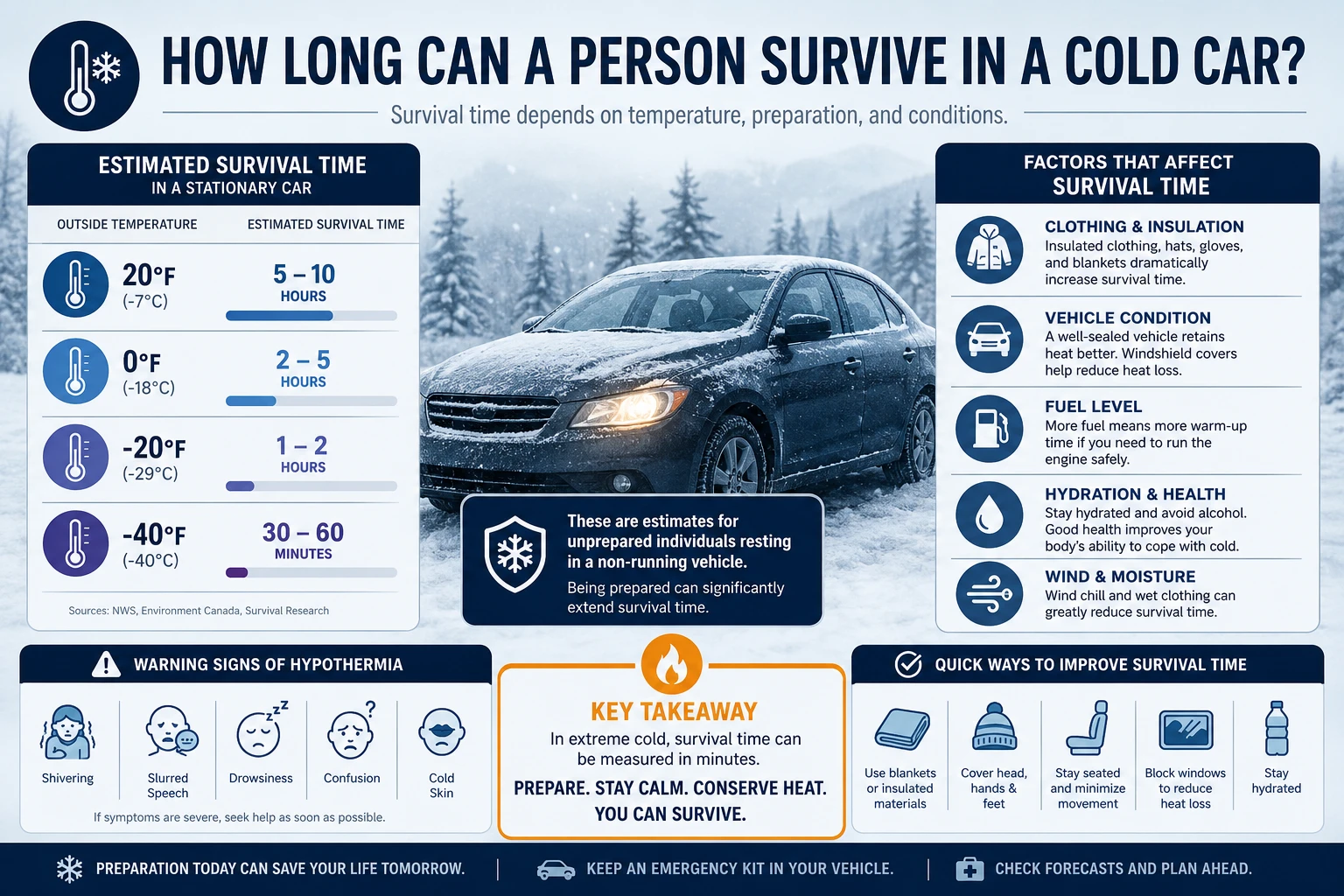
Survival time in a cold vehicle depends on outside temperature, wind chill, body size, available insulation, and whether the person is wet or dry. A healthy adult with no insulation at 20°F (-7°C) may develop hypothermia within 2–3 hours. With a good sleeping bag and Mylar blanket, that same person could survive 24–48 hours or longer.
Key variables that shorten survival time:
- Wet clothing (dramatically accelerates heat loss)
- High wind chill (a car provides shelter, but drafts matter)
- Children, elderly, or people with medical conditions (more vulnerable to rapid core temperature drop)
- No food or water (the body needs fuel to generate heat)
Key variables that extend survival time:
- Layered insulation (blankets, sleeping bag, extra clothing)
- Staying dry
- Caloric intake (even small amounts of food help the body produce heat)
- Staying calm and limiting unnecessary movement that opens doors
The bottom line: a well-prepared person with proper gear can survive a winter stranding for multiple days. An unprepared person in extreme cold can be in serious danger within a few hours.
Signs of Hypothermia When Stuck in a Vehicle
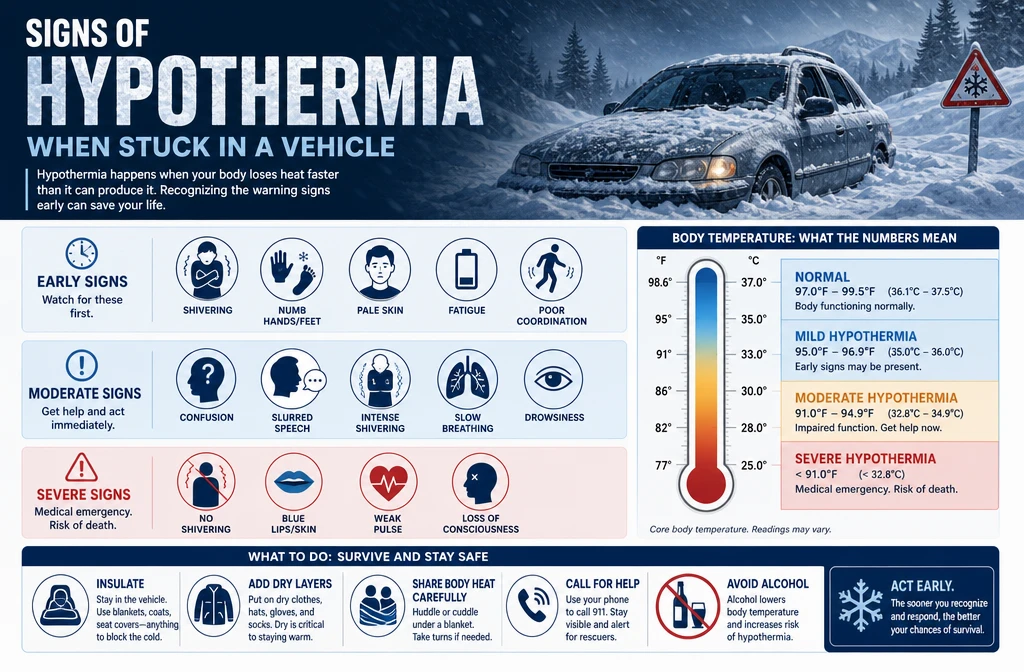
Hypothermia begins when core body temperature drops below 95°F (35°C). Recognizing it early — in yourself or a passenger — is essential because cognitive function degrades as the condition worsens, making self-rescue harder.
Early signs (mild hypothermia, 90–95°F core temp):
- Intense, uncontrollable shivering
- Slurred speech
- Fumbling hands, difficulty with fine motor tasks
- Confusion or unusual irritability
- Pale or bluish skin
Moderate to severe signs (below 90°F core temp):
- Shivering stops (this is dangerous — it means the body is losing the fight)
- Severe confusion or drowsiness
- Stiff muscles
- Slow, weak pulse
- Loss of consciousness
What to do: Add every layer of insulation available immediately. Share body heat if another person is present. Get a chemical hand warmer near the core (armpits, groin, neck) — not on extremities first. Do not rub the skin vigorously. If the person is unconscious, this is a medical emergency — signal for help immediately.
Understanding these warning signs is also covered in our 14 essential survival skills every prepper must know, which includes cold weather medical response.
Is It Safe to Run the Car Engine While Stuck?
Running the engine for heat is safe only when the exhaust pipe is completely clear of snow and ice, and a window is cracked slightly for ventilation. Carbon monoxide (CO) is colorless, odorless, and lethal — it accumulates rapidly inside a sealed vehicle when the exhaust is blocked, and it kills people every winter.
Safe engine use protocol:
- Before starting the engine, physically check and clear the exhaust pipe of snow and ice.
- Crack a downwind window 1–2 inches for fresh air circulation.
- Run the engine in short intervals — roughly 10 minutes per hour — rather than continuously.
- Keep a battery-powered or battery-backup CO detector in your car kit. This is not optional.
- Never run the engine in a closed garage, even with the garage door open.
When NOT to run the engine:
- If you cannot confirm the exhaust pipe is clear
- If you smell exhaust inside the cabin at any point — exit immediately
- If drifting snow is accumulating around the vehicle rapidly
Common mistake: People assume running the engine continuously is safer because it keeps the car warmer. In reality, intermittent running conserves fuel and dramatically reduces CO risk. A tank of gas can last much longer with disciplined intervals.
How to Keep Warm in a Car During a Winter Emergency Without Running the Engine
When the engine isn’t an option — dead battery, blocked exhaust, or empty fuel tank — body heat management and insulation become everything. This is where preparation pays off.
Step-by-step insulation strategy:
- Move to the back seat. It’s smaller and retains body heat better than the front.
- Layer from the ground up. Cold transfers through the seat. Sit on a folded blanket rather than directly on the upholstery.
- Wrap in a Mylar blanket first, then a wool blanket over it. The Mylar reflects radiant heat; the wool traps it.
- Cover your head. An estimated 30–40% of body heat can be lost through an uncovered head.
- Use hand warmers strategically. Place them near your core — inside a jacket against your torso — rather than just in your hands.
- Minimize door openings. Every time a door opens, warm air escapes and cold air enters. If signaling for help, use the window instead.
- Stay hydrated. Dehydration impairs the body’s ability to regulate temperature.
How to Insulate Car Windows During a Winter Emergency
Windows are the weakest thermal point in a vehicle. Glass conducts cold far more efficiently than the insulated doors and roof.
Practical window insulation methods:
- Reflective foam insulation (the kind used for camping sleeping pads) cut to window size and pressed against the glass
- Cardboard from a flat box — not ideal, but effective in a pinch
- Spare clothing or blankets pressed against windows and held in place
- Windshield sunshades (the reflective accordion-style ones) work well for the front windshield and can be repurposed for rear windows
Pre-cut foam inserts for your specific vehicle’s windows can be made at home and stored flat in the trunk. This is a $10–15 prep that makes a measurable difference in cabin temperature retention.
Best Emergency Blankets for Car Survival — and the Difference Between Types
Not all emergency blankets are equal. Choosing the right type before an emergency matters.
| Type | Heat Retention | Durability | Weight | Best For |
|---|---|---|---|---|
| Mylar (single-use foil) | ~90% radiant heat reflected | Tears easily | Very light | Short-term emergencies, budget kits |
| Reusable Mylar (reinforced) | ~85–90% | Much more durable | Light | Car kits, repeated use |
| Wool blanket | High (retains heat when wet) | Very durable | Heavy | Core insulation layer |
| Synthetic fleece blanket | Good (not as high as wool) | Durable | Moderate | Layering, general use |
| 0°F sleeping bag | Excellent | Durable | Moderate-heavy | Extended stranding, extreme cold |
| Wearable emergency poncho blanket | Good | Moderate | Light | Mobility, getting out of vehicle |
Decision rule: Use a Mylar blanket as your first layer (radiant heat reflection), a wool or fleece blanket as your second layer (insulation), and a sleeping bag as your outer layer if temperatures are extreme. Stacking these three creates a system far more effective than any single item alone.
What to Do If the Heater Stops Working While Stranded
If the heater fails — whether from a mechanical issue, dead battery, or empty tank — switch immediately to passive heat retention mode. Don’t wait to feel cold before acting.
Immediate steps:
- Put on every warm layer available — hat, gloves, extra socks, jacket.
- Deploy your emergency blankets and move to the back seat.
- Assess your fuel and battery situation. If the battery is dead, the engine won’t run — focus entirely on insulation.
- If the engine runs but the heater doesn’t, the engine itself still generates heat. Keeping the engine running (safely) will warm the cabin somewhat even without a functioning heater core.
- Signal for help immediately — don’t wait to see if the situation improves.
A dead heater in a winter stranding is a serious escalation. It’s also exactly why a pre-staged car kit matters so much. Your ultimate car emergency kit should be ready before you ever need it.
How Much Food and Water Should I Keep in My Car for Winter?
Food and water directly support your body’s ability to generate heat. Caloric intake fuels thermogenesis — the process by which your body produces warmth. Going without food in extreme cold accelerates the onset of hypothermia.
Recommended minimums for a winter car kit:
- Water: 1 liter per person per day minimum. In winter, store water in insulated containers or a small cooler to prevent freezing. Rotate stock every 6 months. (See our emergency water storage guide for storage best practices.)
- Food: 1,200–2,000 calories per person per day for a 3-day supply. Focus on high-calorie, non-perishable items that don’t freeze solid.
Best car kit food options:
- Peanut butter packets (high fat and protein, calorie-dense)
- Granola bars and energy bars (Clif, RXBAR, or similar)
- Nuts and trail mix
- Jerky
- Hard candy (quick glucose for energy)
- Instant oatmeal packets (if you have a way to heat water)
Avoid foods that require significant preparation or that freeze solid at low temperatures. Check and rotate your car food supply at the start of each winter season.
Cheap Ways to Keep Warm If Your Car Breaks Down
Preparedness doesn’t require expensive gear. Several of the most effective thermal strategies cost almost nothing.
Budget-friendly options:
- Mylar emergency blankets — available in 4-packs for under $10. These are the single best value item in any winter kit.
- Chemical hand warmers — $1–2 each, available at most gas stations and sporting goods stores. Stock 10–20 per person.
- Wool blanket from a thrift store — often $5–15 and just as effective as new.
- Cardboard — free, and a surprisingly good insulator for windows and floor coverage.
- Newspaper — stuff it between clothing layers as emergency insulation. Sounds low-tech; it works.
- Extra clothing layers — the cheapest prep of all. Keep a bag of warm clothes in the trunk: wool socks, a hat, gloves, and a fleece jacket.
- Candles in a tin — a single tea light candle in a small metal container can raise the temperature of a car interior by several degrees. Use with a cracked window for ventilation.
Edge case: If you’re caught without any kit at all, use everything in the car — floor mats, seat covers, luggage, even fast food bags stuffed with napkins — as insulation. Improvised insulation beats nothing.
Common Mistakes People Make When Trapped in a Cold Car
Even prepared people make critical errors under stress. These are the most dangerous ones.
- Leaving the vehicle to walk for help. In a whiteout or remote area, this is almost always fatal. Your car is a shelter. Stay with it.
- Running the engine with a blocked exhaust. The most common cause of CO poisoning in winter stranding situations.
- Wearing cotton as a base layer. Cotton absorbs moisture and loses all insulating value when wet. Wool and synthetics are far superior.
- Ignoring early hypothermia signs. Mild confusion and slurred speech are easy to dismiss. Act on them immediately.
- Not telling anyone your route. If no one knows where you were going, no one knows where to look.
- Draining the battery on phone use. Preserve battery for emergency calls. Put the phone in low-power mode and limit screen time.
- Opening doors repeatedly. Every door opening is a significant heat loss event. Use windows for signaling.
- Assuming rescue will come quickly. In a major storm, emergency services may be hours or days away. Plan for self-sufficiency.
For a broader look at what’s missing from most people’s emergency planning, see 15 things missing from your emergency kit that could cost you everything.
Which Cars Are Best Equipped for Winter Survival?
Some vehicles handle winter emergencies better than others — not just for driving in snow, but for surviving a stranding.
Features that matter most:
- All-wheel drive or 4WD — reduces the chance of getting stuck in the first place
- Large fuel tank — more fuel means more heat capacity if running the engine intermittently
- High ground clearance — less likely to get buried in a drift
- Good door and window seals — reduces drafts and heat loss
- 12V power outlets — for phone charging and portable heaters
- Trunk access from inside the cabin — critical if the trunk is blocked by snow
Best vehicle types for winter survival scenarios:
- Full-size trucks and SUVs (large fuel tanks, high clearance, 4WD)
- All-wheel drive crossovers (balance of capability and fuel efficiency)
- Older body-on-frame SUVs (durable, repairable, high clearance)
Worst types for winter stranding:
- Low-clearance sedans with small fuel tanks
- Electric vehicles (range drops significantly in cold, and there’s no engine heat)
- Sports cars with summer tires
Regardless of vehicle type, the car kit you carry matters more than the vehicle itself once you’re already stranded.
Frequently Asked Questions
Should I stay in my car or try to walk out during a winter emergency?
Stay in your car in almost every situation. A vehicle is a visible shelter that rescuers can find. Walking in a blizzard or unfamiliar terrain dramatically increases the risk of getting lost, exhausted, and exposed. The only exception is if you can clearly see a safe building within a short distance and conditions allow safe travel.
How do I signal for help if I’m stranded in a snowstorm?
Turn on your hazard lights to preserve battery, then use road flares or LED triangles placed behind the vehicle. Tie a brightly colored cloth or flag to the antenna or door handle. If you have a whistle, use it when you hear vehicles or rescuers nearby. A signal mirror works well in daylight.
Can I use a propane heater inside my car?
Small propane or butane heaters designed for indoor use (like the Mr. Heater Buddy) can be used with a cracked window for ventilation, but this carries CO and fire risks. They should be a last resort, used briefly, and never left unattended or run while sleeping.
How do I keep water from freezing in my car kit?
Store water bottles in an insulated bag or small soft cooler inside the cabin rather than the trunk. The cabin retains more heat than the trunk. You can also keep water bottles close to your body under blankets. If water does freeze, body heat or a hand warmer placed against the bottle will thaw it slowly.
What’s the best way to share body heat in a stranded car?
Two or more people sharing a sleeping bag or wrapped together under blankets is significantly more effective than each person insulating separately. The combined body heat creates a much warmer microclimate. This is especially important if one person is showing signs of hypothermia.
How do I keep children warm in a car during a winter emergency?
Children lose heat faster than adults due to their smaller body mass. Wrap them in layers immediately, place them between adults if possible, and use hand warmers near their core (not directly on skin). Keep them fed and hydrated. Don’t let them sleep directly against cold windows or doors.
Is it safe to burn candles inside a car for warmth?
A single tea light candle in a metal container can raise cabin temperature a few degrees and is generally safe with a slightly cracked window. Use a stable holder, never leave it unattended, and keep it away from any flammable materials. It’s a supplement to insulation, not a replacement.
How often should I check and restock my winter car kit?
At the start of each winter season (October or November in most northern climates). Check expiration dates on food and water, test the flashlight batteries, and replace any used hand warmers. A 15-minute annual check is all it takes.
What if my phone dies and I can’t call for help?
This is why a 12V car charger and a portable power bank belong in every car kit. If both are unavailable, use your car’s hazard lights, road flares, and physical signals to attract attention. A whistle carries farther than a voice in wind and snow.
Can hypothermia happen even if it’s not extremely cold outside?
Yes. Hypothermia can develop at temperatures well above freezing — especially if a person is wet, exhausted, or has been exposed for a long time. Wet clothing at 50°F (10°C) can cause hypothermia faster than dry clothing at 20°F (-7°C).
Conclusion: Preparedness Is the Difference Between a Story You Tell and One Someone Tells About You
Knowing how to keep warm in a car during a winter emergency isn’t a skill reserved for extreme survivalists or people who live in the far north. Anyone who drives in winter — anywhere temperatures drop — is one unexpected storm, one mechanical failure, or one wrong turn away from a cold-weather stranding.
The action steps are straightforward:
- Build your winter car kit now — before the first snow, not during a storm.
- Learn to recognize hypothermia in yourself and others.
- Practice the engine-running protocol so it’s automatic under stress.
- Tell someone your route every time you drive in winter conditions.
- Stay with your vehicle unless you have a compelling, clear reason to leave.
For a broader preparedness framework that covers scenarios beyond the vehicle, the ultimate home emergency preparedness guide and the 4-layer disaster plan are strong next steps. And if you’re building out your overall emergency kit strategy, 15 things missing from your emergency kit is worth reading before you think you’re done.
Being prepared isn’t about fear. It’s about knowing that when the temperature drops and the road disappears, you have what you need to protect yourself and the people with you.
Products, Tools, and Resources Worth Having
These are practical, field-tested items that belong in a winter car survival kit. No fluff — just what actually works.
- HotHands Hand Warmers (40-pack): Reliable, long-burning (10+ hours), and inexpensive. Keep at least 10 per person in your kit.
- Swiss Safe Emergency Mylar Blankets (4-pack): Reinforced Mylar that’s more durable than the cheap foil versions. Under $10 and worth every cent.
- Wise Owl Outfitters Blanket: Heavy, durable, and retains warmth when damp. A one-time purchase that lasts years.
- Mr. Heater F232000 Portable Propane Heater: For extended cold-weather emergencies where passive insulation isn’t enough. Use with strict ventilation discipline.
- Kidde Battery-Operated CO Detector: Small, battery-powered, and essential if you’re running the engine for heat. Around $20 and non-negotiable.
- LifeStraw Personal Water Filter: In case you need to melt and filter snow for water during a prolonged stranding.
- Anker PowerCore Portable Charger (20,000 mAh): Keeps your phone alive when the car battery is dead or you’re conserving fuel.
- Fiskars Folding Shovel: Compact, sturdy, and essential for clearing the exhaust pipe and digging out tires.
- CLIF Bars (variety pack): High-calorie, don’t freeze solid at moderate temperatures, and have a long shelf life. Rotate annually.
For a complete gear framework beyond just the car, the essential survival gear guide ranks 50 items by priority — a useful reference when building out any preparedness system.