

Hey there! Some links on this page may be affiliate links which means that, if you choose to make a purchase, I may earn a commission at no extra cost to you. I greatly appreciate your support. Read the full disclosure here.
A single acre of land, roughly the size of a football field, has fed families, raised livestock, and built genuine self-reliance for generations. The question isn’t whether homesteading on 1 acre what is possible is a real option. The question is how much you can actually pull off, and whether the effort is worth it for someone serious about preparedness and long-term independence.
The short answer: one acre is enough to produce a meaningful portion of a family’s food, support small livestock, and dramatically reduce dependence on grocery stores and supply chains. It won’t make most families 100% self-sufficient, but it can get a household of four to 40-60% food independence with smart planning.
Key Takeaways
- One acre can realistically support a productive vegetable garden, a small orchard, chickens, rabbits, and possibly goats, with careful zoning.
- A well-managed quarter-acre vegetable garden can produce 1,000 to 2,000+ pounds of food per year, depending on climate and crop selection.
- Full self-sufficiency on one acre is difficult but partial self-sufficiency, covering vegetables, eggs, and some meat, is very achievable.
- Chickens are the single best livestock investment for a one-acre homestead: low cost, low space, high return in eggs and meat.
- Dairy goats can work on one acre but require rotational grazing management and supplemental feed.
- Cows are generally not practical on one acre, they need a minimum of 1.5 to 2 acres per animal.
- The most common small-homestead mistake is trying to do everything at once instead of building systems one layer at a time.
- A one-acre homestead can save a family of four an estimated $3,000 to $6,000 annually in food costs once fully productive.
- From a prepper standpoint, a productive one-acre homestead is one of the most powerful long-term resilience investments available.
What Can You Realistically Grow on a 1 Acre Homestead
A one-acre homestead can grow enough vegetables, fruits, and herbs to cover a significant share of a family’s annual food needs. The realistic scope depends on your climate, soil quality, water access, and how much of that acre you dedicate to food production.
Most productive small homesteads dedicate roughly a quarter to a half acre to gardens and orchards, keeping the rest for structures, pathways, livestock, and compost systems. Within that footprint, here’s what’s achievable:
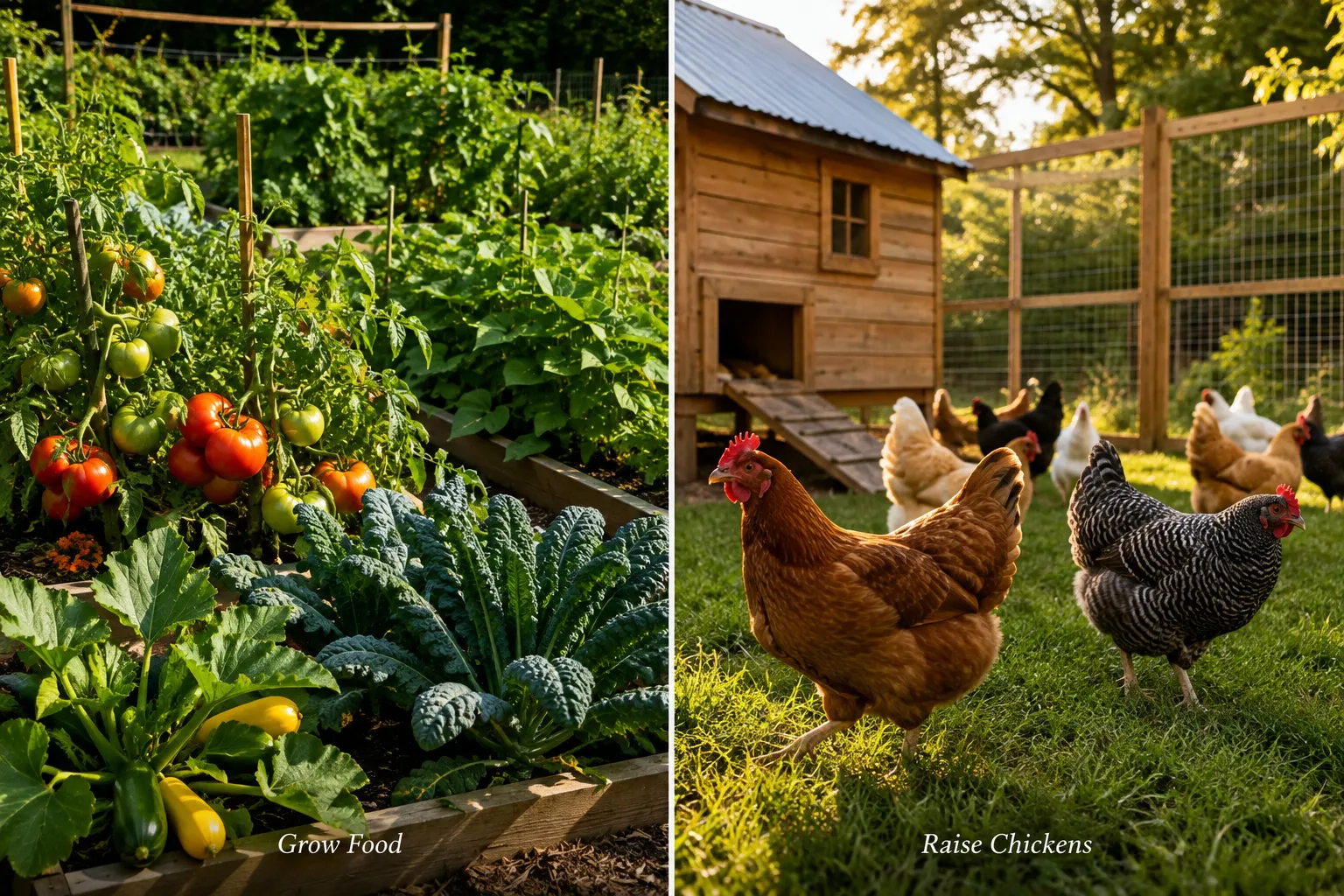
- Vegetables: A 2,000 to 5,000 square foot garden can produce year-round staples including tomatoes, squash, beans, kale, carrots, potatoes, and peppers.
- Fruit trees: Dwarf and semi-dwarf varieties (apple, pear, plum, peach) can fit 6 to 12 trees in a quarter-acre orchard block.
- Berries: Strawberries, raspberries, and blueberries are high-yield, low-space crops that work well along fence lines.
- Herbs and medicinals: A dedicated 100-200 square foot herb bed can supply culinary and medicinal herbs year-round.
Best crops for beginners on small acreage include zucchini, green beans, kale, sweet potatoes, and tomatoes, all high-yield, relatively forgiving, and calorie-dense. For preppers specifically, prioritize calorie crops (potatoes, winter squash, dried beans) alongside nutrient-dense greens.
Start Homesteading From Scratch
How Much Food Can 1 Acre Produce Per Year
One acre, intensively managed, can produce thousands of pounds of food annually. A quarter-acre vegetable garden using intensive planting methods can yield between 1,000 and 2,000 pounds of produce per year. A half-acre dedicated to mixed vegetables, fruit trees, and berries can push that to 3,000 to 5,000 pounds.
To put that in context: the USDA estimates the average American consumes roughly 1,500 pounds of food per year. A well-run half-acre garden and small orchard can theoretically cover the vegetable and fruit needs of a family of four, but it won’t cover grains, dairy, or significant meat production without additional land or purchased feed.
Factors that most affect yield:
- Soil health and amendment (compost, cover crops, mulch)
- Irrigation reliability, water access is often the limiting factor
- Season extension tools (row covers, cold frames, hoop houses)
- Succession planting to keep beds productive across seasons
1 Acre Homestead Layout and Planning
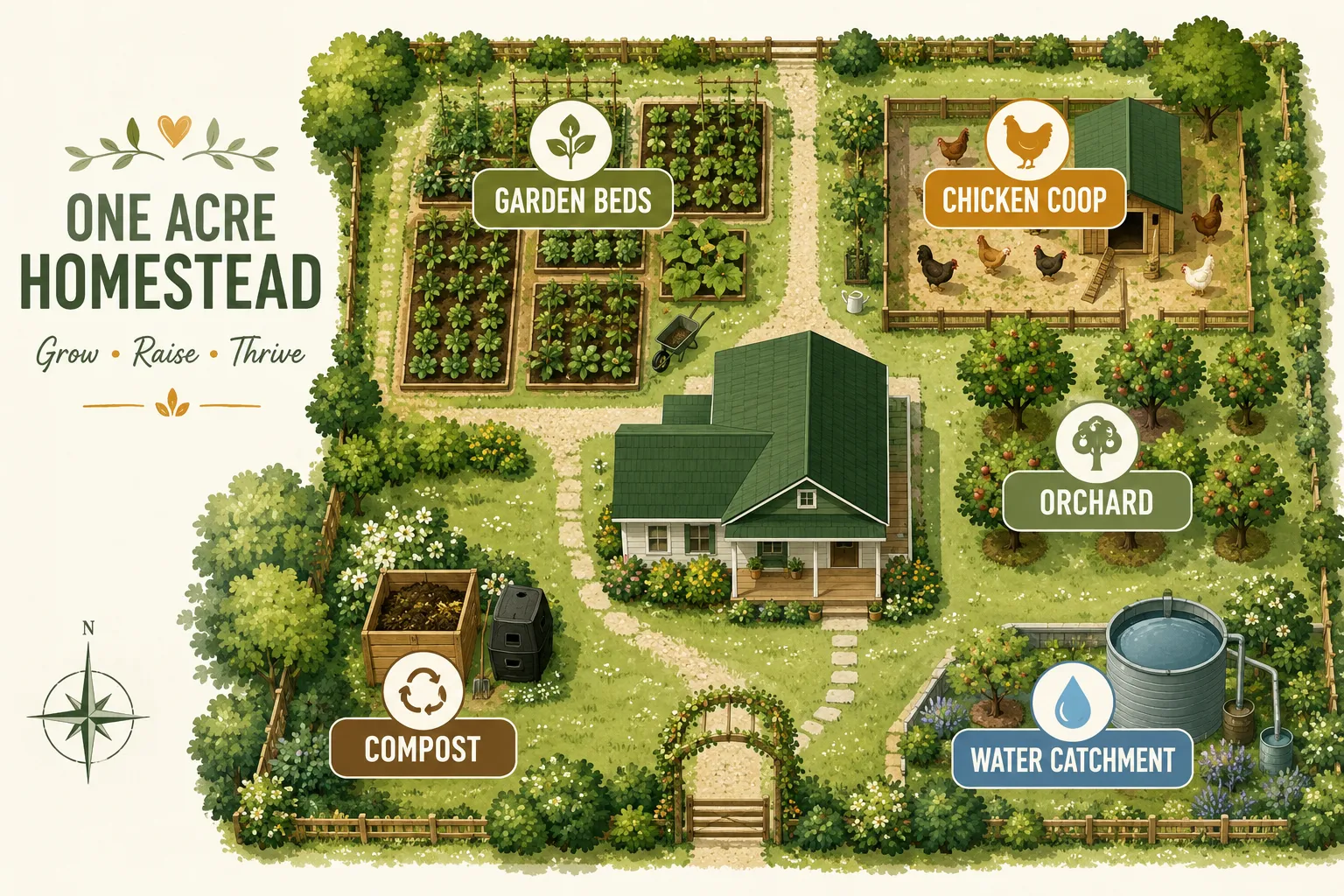
A functional one-acre homestead layout follows a zoning principle: place the highest-maintenance elements closest to the house, and lower-maintenance systems further out.
A practical layout for a one-acre prepper homestead looks like this:
Zone 1, Immediate house perimeter (0 to 30 feet): Herb garden, salad greens, kitchen scraps compost bin. Daily access, easy to tend.
Zone 2, Main garden area (30 to 150 feet): Raised beds or in-ground vegetable garden, cold frames, seed starting greenhouse.
Zone 3, Livestock area: Chicken coop and run, rabbit hutches. Positioned downwind from the house, with easy access for daily feeding and egg collection.
Zone 4, Orchard and perennial crops: Fruit trees, berry bushes, asparagus beds. Lower maintenance once established.
Zone 5, Utility and storage: Compost systems, water catchment tanks, tool storage, firewood.
The most common layout mistake is placing the garden too far from the house. Distance kills consistency, if tending the garden feels like a separate trip, it gets neglected.
How Many Animals Can You Raise on 1 Acre
A one-acre homestead can support a meaningful small livestock operation, but it requires honest planning about space, feed, and manure management.
Practical livestock options for one acre:
- Chickens (6 to 20 birds): The best fit for small acreage. Six laying hens produce 4 to 5 eggs per day. Twenty birds can supply eggs and occasional meat with minimal footprint. A coop and run can fit in 200 to 400 square feet.
- Rabbits (4 to 8 does): Extremely space-efficient. Four breeding does can produce 80 to 100 pounds of meat per year in a small hutch setup.
- Ducks (4 to 10 birds): Similar to chickens, good layers, excellent for pest control in wet climates.
- Meat birds (batch raising): 25 to 50 Cornish Cross broilers can be raised in a moveable pen (chicken tractor) in 8 weeks, yielding 100+ pounds of meat per batch.
Can You Raise Goats or Cows on 1 Acre
Goats are possible on one acre; cows are not practical. A single Nigerian Dwarf or Pygmy goat needs a minimum of 200 square feet of pen space, but for productive dairy goats (Nigerian Dwarf, Nubian), plan for at least two animals (goats are herd animals and suffer alone) and a small pasture of 1,000 to 2,000 square feet per animal, plus supplemental hay and grain.
Two dairy goats on one acre is workable if you manage pasture rotation carefully and supplement with purchased hay. Expect 1 to 2 quarts of milk per day from a Nigerian Dwarf doe.
Standard dairy cows (Holstein, Jersey) need a minimum of 1.5 to 2 acres per animal for grazing alone, plus additional land for hay production. On one acre, a cow is a net drain, you’ll spend more on purchased feed than the milk is worth. Miniature cattle breeds (Dexter, Miniature Hereford) can work on slightly more land, but one acre is still tight.
Chicken Coop and Garden Setup for 1 Acre
The chicken-garden combination is the backbone of a productive one-acre homestead. Chickens and gardens work together when managed correctly, and against each other when they’re not.
A functional setup:
- Place the coop at the edge of the garden zone, not inside it.
- Use a moveable chicken tractor to rotate birds across garden beds in the off-season, they scratch out weeds and fertilize simultaneously.
- Size the permanent run at a minimum of 10 square feet per bird (more is better).
- Compost chicken manure for 60 to 90 days before applying to garden beds, fresh manure burns plants.
- Plant a small “chicken garden” of sunflowers, comfrey, and herbs near the coop to supplement feed and reduce costs.
For preppers, chickens represent one of the most resilient food systems available. They produce eggs daily with minimal input, can forage a significant portion of their own diet in warmer months, and reproduce readily if you keep a rooster.
Is 1 Acre Enough to Be Self-Sufficient
Full self-sufficiency on one acre is not realistic for most families. Partial self-sufficiency, covering 40 to 70% of food needs, is very achievable with the right systems in place.
The gap is primarily in calories. Grains (wheat, corn, oats) require significant acreage to produce meaningful quantities. One acre of wheat yields roughly 40 to 60 pounds of flour, not enough to feed a family for a year. Meat production at scale also demands more land than one acre can support.
Where one acre genuinely delivers:
- 100% of vegetable and herb needs (with good garden management)
- 80 to 100% of egg needs
- A significant portion of fruit needs
- Supplemental meat from chickens, rabbits, and fish (if you add a small pond)
From a prepper’s perspective, the goal isn’t perfection, it’s resilience. A homestead that covers 50% of your food needs cuts your supply chain exposure in half. That’s a powerful position in any disruption scenario.
1 Acre Homestead vs Buying From the Store: Cost Comparison
A one-acre homestead requires upfront investment but pays back steadily over time. Initial setup costs for a basic productive homestead, raised beds, soil amendment, tools, seeds, a chicken coop, and basic irrigation, typically run $2,000 to $5,000 depending on what you already own and how much you DIY.
Once productive (typically year two or three), a well-run one-acre homestead can realistically save a family of four:
- Vegetables and herbs: $1,500 to $3,000 per year (replacing store-bought organic produce)
- Eggs: $400 to $800 per year (6 to 12 hens)
- Meat (chickens, rabbits): $500 to $1,500 per year depending on production volume
- Fruit: $300 to $600 per year
Estimated annual savings: $2,700 to $5,900. Most homesteads recoup their setup costs within two to three years and run at a net positive thereafter.
The store wins on convenience and grain products. The homestead wins on quality, security, and long-term cost, especially if food prices continue rising.
What’s the Difference Between a 1 Acre and 5 Acre Homestead
One acre forces prioritization. Five acres allows expansion. The difference isn’t just scale, it’s what becomes possible.
| Capability | 1 Acre | 5 Acres |
|---|---|---|
| Full vegetable self-sufficiency | Possible | Easily achieved |
| Grain production | Not practical | Possible (1-2 acres of grain) |
| Dairy cow | Not practical | Yes (1-2 animals) |
| Full meat self-sufficiency | Partial | Achievable |
| Orchard | Small (6-12 trees) | Full orchard (20-50 trees) |
| Hay production | No | Yes |
| Market gardening | Limited | Viable income source |
For preppers starting out, one acre is an excellent proving ground. The skills, systems, and habits you build on one acre transfer directly to larger land, and one acre done well beats five acres done poorly every time.
Common Mistakes People Make With Small Homesteads
The biggest mistake on a small homestead is overcommitting in year one. New homesteaders frequently plant too much, add too many animals, and exhaust themselves before any system is working well.
The most damaging small-homestead mistakes:
- Starting too big: Plant a manageable garden first. A 400 square foot bed managed well beats a 2,000 square foot disaster.
- Skipping soil work: Poor soil is the single biggest yield killer. Invest in compost and soil testing before buying seeds.
- No water plan: Relying on hand-watering a large garden is unsustainable. Install drip irrigation or at minimum a rain barrel system early.
- Buying animals before infrastructure: Never bring livestock home before the coop, fencing, and feed storage are ready.
- Ignoring perennials: Annual vegetables take constant work. Fruit trees, berry bushes, and perennial herbs build permanent food systems that compound over time.
- No preservation plan: Growing 200 pounds of tomatoes means nothing if you can’t preserve them. Learn canning, dehydrating, and fermentation before you need them.
How to Maximize Productivity on Limited Land
Maximizing a one-acre homestead comes down to stacking functions, every element should serve more than one purpose.
High-impact productivity strategies:
- Vertical growing: Trellised beans, cucumbers, and tomatoes double yield per square foot.
- Succession planting: As one crop finishes, another goes in. A single bed can produce three or four crops per season.
- Companion planting: Three Sisters (corn, beans, squash) maximize space and naturally support each other.
- Integrated pest management: Chickens, ducks, and beneficial insect plantings reduce pest pressure without chemicals.
- Compost everything: Kitchen scraps, chicken manure, garden waste, all return to the soil. A closed-loop system reduces input costs and builds soil over time.
- Rainwater harvesting: A 1,000-gallon tank fed by roof runoff can cover significant irrigation needs during dry periods.
For preppers, productivity also means redundancy. Grow multiple varieties of each crop. Keep seed stock. Maintain more than one water source. A productive homestead that depends on a single point of failure isn’t truly resilient.
Is 1 Acre Homesteading Worth the Effort and Time
For preppers and survivalists, the answer is almost always yes, but with clear eyes about what you’re signing up for.
A productive one-acre homestead requires 1 to 3 hours of daily work during peak growing season, dropping to 30 to 60 minutes in winter. That’s a real commitment. The return isn’t just food, it’s skills, confidence, and a resilience infrastructure that no supply chain disruption can take away.
The people who thrive on small homesteads share a few traits: they start small and expand deliberately, they’re willing to learn from failure, and they see the work as a long-term investment rather than a short-term project.
The people who burn out try to replicate a five-acre operation on one acre in year one.
For anyone serious about long-term self-reliance, a one-acre homestead is one of the highest-leverage preparedness investments available. It builds food security, practical skills, and physical resilience simultaneously, and it does it in a footprint that’s accessible to a large portion of the population.
Conclusion
Homesteading on 1 acre, what is possible, is a question with a genuinely encouraging answer. One acre is enough to grow most of a family’s vegetables, raise chickens and rabbits for eggs and meat, establish a small orchard, and build the kind of hands-on self-reliance that no amount of stored supplies can fully replace.
It won’t replace the grocery store entirely. But it will make you far less dependent on it, and in a disruption scenario, that difference is everything.
Actionable next steps for 2026:
- Map your acre using the zoning system above, identify where your garden, coop, and orchard will go before you break ground.
- Start with soil. Get a basic soil test ($15 to $30 from most county extension offices) and amend before planting.
- Plant your first garden small and intensive, 400 to 800 square feet of well-managed beds beats an acre of chaos.
- Add 6 to 8 laying hens in year one. They’re the easiest livestock win available and immediately productive.
- Begin a compost system on day one. Every scrap of organic material is future soil.
- Learn preservation before you need it, canning, dehydrating, and fermentation are force multipliers for everything you grow.
The land is there. The knowledge is available. The only thing left is to start.
Products, Tools, and Resources
Building a productive one-acre homestead is easier with the right tools from the start. These are the categories worth investing in early:
Garden infrastructure: Quality raised bed kits or untreated cedar lumber, a reliable drip irrigation system, and heavy-duty row covers for season extension are foundational. Cheap versions of all three fail quickly and cost more over time.
Soil and seeds: A soil test kit and a supply of open-pollinated, non-hybrid seeds (stored in a cool, dry location) are essential for any prepper-focused homestead. Open-pollinated varieties let you save seed year after year, a critical resilience feature.
Livestock basics: For chickens, a well-built coop with hardware cloth (not chicken wire, which predators defeat easily), a gravity-fed waterer, and a quality feeder reduce daily labor significantly. For goats, a solid three-strand electric fence is the minimum.
Preservation equipment: A water bath canner, a pressure canner, a food dehydrator, and mason jars in multiple sizes cover the majority of preservation needs. A vacuum sealer extends the shelf life of dried goods considerably.
Reference library: John Jeavons’ “How to Grow More Vegetables” is the definitive guide to intensive small-plot food production. Carla Emery’s “The Encyclopedia of Country Living” covers nearly every homesteading skill in practical depth. Both belong on every serious homesteader’s shelf.
For deeper reading on related preparedness topics, the guides at Preppers HQ on off-grid living, emergency water storage, and long-term food storage provide the broader self-reliance framework that makes a one-acre homestead even more effective.