
Hey there! Some links on this page may be affiliate links which means that, if you choose to make a purchase, I may earn a commission at no extra cost to you. I greatly appreciate your support. Read the full disclosure here.
Complete guide to emergency food rationing and cooking
Emergency food rationing and cooking isn’t about hoarding—it’s about having a system that turns stored food into actual survival. You can have a garage full of rice and beans, but if you don’t know how to ration it properly, cook it efficiently, or maintain morale while eating it for 30 days straight, you’re not prepared. You’re just well-stocked.
The harsh truth is that most people with emergency food supplies will run out in 10-14 days, not because they didn’t store enough, but because they ate it wrong. They cooked inefficiently, wasted fuel, failed to track consumption, and let panic eating destroy their carefully built reserves. And when the food runs out with two weeks still to go, all that preparation becomes worthless.
This isn’t theoretical. During Hurricane Katrina, families with adequate food supplies still went hungry because they couldn’t cook without power. During the 2021 Texas freeze, people with full pantries couldn’t prepare meals because they had no alternative cooking methods. Having food isn’t enough. You need the knowledge, skills, and systems to make that food last and actually feed your family.
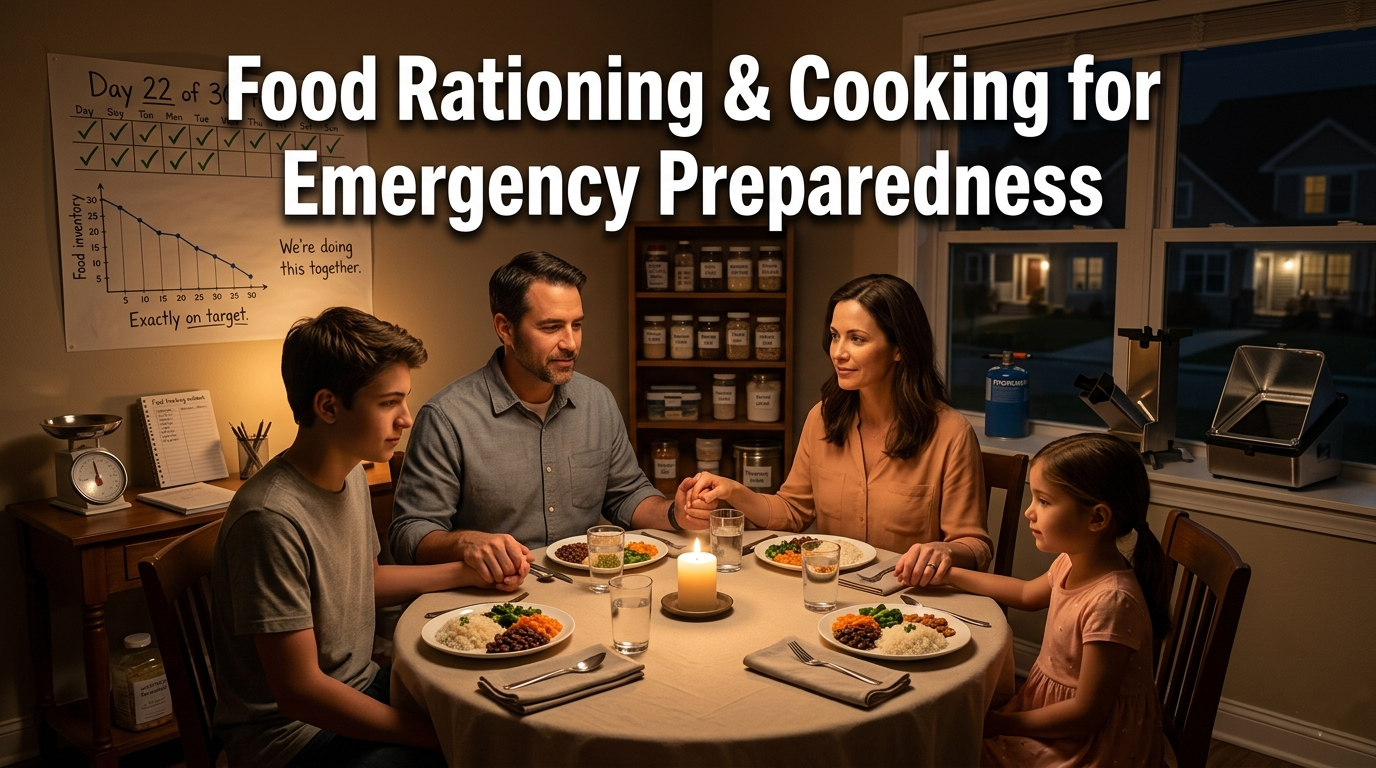
This is your complete 30-day food rationing and cooking guide—from calculating exactly how much you need, to cooking efficiently without power, to maintaining morale when every meal feels like a sacrifice.
Find this useful? Add us as a preferred source on Google and more of what we publish will show up in your results.
Why Emergency Food Rationing and Cooking Skills Are Your Most Critical Survival Asset
 Before you buy another bag of rice or case of canned goods, understand why rationing and cooking skills matter more than the food itself.
The Harsh Reality of Emergency Food Scarcity
In a real emergency—natural disaster, economic collapse, supply chain breakdown—food becomes the most critical resource. But scarcity doesn’t just mean “not enough food exists.” It means:
Distribution fails: Stores are empty within 72 hours. Resupply stops: Trucks aren’t running, deliveries cease. Duration is unknown: You don’t know if it’s 2 weeks or 2 months. Sharing pressure: Family, friends, neighbors all need help
Your stored food isn’t just for your household’s calculated needs. It’s your buffer against uncertainty, your bargaining chip, your psychological anchor. Waste it through poor rationing, and you’ve lost more than calories—you’ve lost security.
Why Having Food Isn’t Enough (The Cooking Crisis)
The scenario: You have 60 pounds of rice, 40 pounds of beans, and 50 cans of vegetables. That’s theoretically 60+ days of food for one person. But:
- No cooking fuel: Your electric stove doesn’t work, and you have no propane
- No cooking knowledge: You’ve never cooked dried beans from scratch
- No water plan: Cooking rice requires 2 cups of water per cup of rice
- No variety strategy: By day 5, you’re so sick of plain rice you can barely eat
Result: Your 60-day supply becomes a 15-day supply because you’re eating inefficiently, wasting food, and are unable to prepare what you have.
The Psychology of Rationing: Maintaining Morale Under Stress
Food isn’t just fuel—it’s comfort, routine, and normalcy. When you start rationing, you’re not just reducing calories. You’re reducing:
Psychological security: Smaller portions trigger scarcity anxiety. Social bonding: Meals are when families connect. Sensory pleasure: Food is one of the few joys in crisis. Control: Eating is one thing you can still control
The challenge: Implement rationing without destroying morale. This requires:
- Gradual reduction (not sudden deprivation)
- Variety maintenance (different meals, not the same thing daily)
- Strategic treats (small morale boosters)
- Fair distribution (everyone sacrifices equally)
Real Emergency Scenarios That Demand Rationing Skills
Hurricane aftermath (2-4 weeks):
- No power for cooking
- Limited water for food preparation
- High heat increases calorie needs
- Spoilage of refrigerated food
Winter storm/grid failure (1-3 weeks):
- No heat increases calorie needs (the body burns more to stay warm)
- Limited cooking options (indoor safety concerns)
- Water may freeze
- Fuel conservation critical
Economic collapse/supply chain breakdown (indefinite):
- No resupply timeline
- Must stretch food as long as possible
- A barter economy may emerge (food as currency)
- Psychological endurance test
The short version: Food rationing for emergency preparedness requires calculating 1,200-2,000 calories per person per day (36,000-60,000 calories for 30 days per person). Implement progressive rationing: Week 1 (100% portions), Week 2-3 (75% portions), Week 4+ (50-60% portions). Essential skills include alternative cooking methods (propane stoves, rocket stoves, solar ovens), fuel-efficient one-pot meals, and inventory tracking to prevent overconsumption.
Key Takeaways:
– Successful emergency food preparedness depends not just on storage but on mastering rationing, cooking without power, and maintaining psychological morale.
– Calculate precise calorie needs per person (1,200-2,500 daily depending on activity and conditions) and add a 20% buffer to your food supply for safety.
– Use progressive rationing: start with full portions in Week 1, reduce to 75% in Weeks 2-3, then 50-60% in Week 4+, while prioritizing protein, fats, and micronutrients.
– Employ alternative cooking methods such as propane stoves, rocket stoves, solar ovens, and fuel-saving techniques like one-pot meals and haybox cooking to conserve fuel.
– Implement strict inventory tracking, fair portion control, variety in meals, and morale strategies (rituals, treats, distraction) to prevent panic eating and ensure supplies last the full duration.
How Much Food Do You Actually Need? (The Rationing Math)
 Before you can ration effectively, you need to know your baseline requirements.
Daily Calorie Requirements in Emergency Situations
Baseline needs: 1,200-2,000 calories per person per day
Minimum survival: 1,200 calories/day (sedentary, short-term only) Moderate activity: 1,500-1,800 calories/day (light work, walking) Active survival: 2,000-2,500 calories/day (manual labor, cold weather)
Why the range? Calorie needs depend on:
- Basal metabolic rate (BMR): Your body’s baseline energy needs
- Activity level: Physical work burns additional calories
- Temperature: Cold weather increases calorie needs (thermogenesis)
- Stress: Psychological stress slightly increases metabolism
Activity level adjustments (sedentary vs. active survival)
Sedentary (sheltering in place):
- Minimal physical activity
- Climate-controlled environment
- Needs: 1,200-1,500 calories/day
Moderate (light survival tasks):
- Walking, light cleaning, basic tasks
- Some temperature exposure
- Needs: 1,500-1,800 calories/day
Active (manual labor, cold exposure):
- Chopping wood, hauling water, and repairs
- Outdoor work in cold weather
- Needs: 2,000-2,500+ calories/day
Age, gender, and health considerations
Children (ages 4-8): 1,200-1,400 calories/day Children (ages 9-13): 1,400-2,000 calories/day Teens (14-18): 2,000-2,800 calories/day (growing, high metabolism) Adult women: 1,600-2,000 calories/day Adult men: 2,000-2,500 calories/day Elderly (65+): 1,600-2,000 calories/day (lower metabolism) Pregnant/nursing: Add 300-500 calories/day
The 30-Day Food Supply Calculation
Single person: 36,000-60,000 calories minimum
Conservative (1,200 cal/day): 36,000 calories (30 days) Moderate (1,500 cal/day): 45,000 calories (30 days) Active (2,000 cal/day): 60,000 calories (30 days)
What this looks like in food:
- 60 pounds of rice (1,680 calories/pound) = 100,800 calories
- 40 pounds of beans (1,600 calories/pound) = 64,000 calories
- 50 cans of vegetables (100 calories/can) = 5,000 calories
- Total: 169,800 calories (enough for 85-140 days at 1,200-2,000 cal/day)
Family of four: 144,000-240,000 calories
Conservative: 144,000 calories (30 days, 1,200 cal/person/day) Moderate: 180,000 calories (30 days, 1,500 cal/person/day) Active: 240,000 calories (30 days, 2,000 cal/person/day)
Buffer planning (add 20% for safety)
Always add a 20% buffer to your calculations:
- Waste: Cooking losses, spoilage, dropped food
- Sharing: Helping neighbors or family members
- Miscalculation: Underestimating needs
- Extended duration: Emergency lasts longer than expected
Example: If you calculate 180,000 calories needed, store 216,000 calories (180,000 × 1.20)
Macronutrient Balance in Rationing
Calories aren’t enough—you need balanced nutrition.
Carbohydrates: 45-65% of calories
Why: Primary energy source, brain fuel, readily available in stored foods. Sources: Rice, pasta, oats, beans, canned fruits. Calculation: 1,500 cal/day × 55% = 825 calories from carbs (206g at 4 cal/g)
Protein: 10-35% of calories
Why: Muscle maintenance, immune function, satiety. Sources: Beans, canned meats, peanut butter, protein powder. Calculation: 1,500 cal/day × 20% = 300 calories from protein (75g at 4 cal/g)
Fats: 20-35% of calories
Why: Energy density, vitamin absorption, satiety, warmth. Sources: Cooking oil, nuts, peanut butter, canned fish. Calculation: 1,500 cal/day × 25% = 375 calories from fat (42g at 9 cal/g)
The Emergency Food Rationing System: From Abundance to Scarcity
 Progressive rationing prevents panic eating and extends your food supply.
Week 1: Normal Rationing (Full Portions)
Establishing baseline consumption
Week 1 is about establishing your baseline and psychologically preparing for the reduction.
Goals:
- Eat normal portions (100% of calculated needs)
- Track actual consumption (what you really eat vs. what you planned)
- Identify high-consumption items
- Practice alternative cooking methods
Why start at 100%? Sudden deprivation causes:
- Panic eating (hoarding food, sneaking extra)
- Morale collapse (resentment, depression)
- Physical shock (hunger, weakness, poor decision-making)
Psychological preparation for reduction
Use Week 1 to prepare your family:
- Explain the plan: “We’re starting at normal portions, then gradually reducing.”
- Set expectations: “This is temporary, and we’re doing it together.”
- Establish fairness: “Everyone gets the same portions, no exceptions.”
- Create rituals: Maintain meal times, family dinners, and gratitude practices
Inventory assessment and planning
Daily tracking:
- Record what you eat (item, quantity, estimated calories)
- Note cooking fuel used (propane, wood, etc.)
- Track water consumption for cooking
- Identify waste (uneaten food, cooking losses)
Weekly review:
- Calculate actual consumption vs. planned
- Adjust the Week 2 plan based on reality
- Identify items running low
- Plan variety for morale
Week 2-3: Moderate Rationing (75% Portions)
Reducing portion sizes strategically
Week 2-3 reduces portions to 75% of baseline (1,125-1,500 calories/day for most adults).
How to reduce without feeling deprived:
- Smaller plates: Visual trick makes portions look larger
- Slower eating: Chew thoroughly, put the fork down between bites
- More meals: Split daily calories into 4-5 small meals instead of 3 large ones
- Volume foods: Add low-calorie bulk (see below)
Maximizing satiety with volume foods
High-volume, low-calorie additions:
- Cabbage: 25 calories per cup, adds bulk to soups/stews
- Canned vegetables: 50-100 calories per can, fills the stomach
- Oatmeal: Absorbs water, expands in the stomach
- Broth-based soups: Water volume creates fullness
Strategy: Maintain plate size, but fill half with low-calorie vegetables
Managing hunger and expectations
Physical hunger management:
- Protein timing: Eat protein at every meal (reduces hunger hormones)
- Fiber: Slows digestion, extends fullness
- Water: Drink water before meals (fills stomach)
- Hot liquids: Tea, broth (creates a warmth and fullness sensation)
Psychological hunger management:
- Distraction: Keep busy (boredom increases perceived hunger)
- Sleep: Adequate sleep regulates hunger hormones
- Stress management: Stress eating is real—find non-food coping
- Gratitude: Focus on what you have, not what you’re missing
Week 4+: Strict Rationing (50-60% Portions)
Survival-level calorie restriction
Week 4+ reduces to 50-60% of baseline (600-1,200 calories/day). This is survival-level rationing, not sustainable in the long term.
What to expect:
- Constant hunger: This is expected
- Fatigue: Reduced energy, need more rest
- Irritability: Low blood sugar affects mood
- Weight loss: 1-2 pounds per week (expected and safe short-term)
Prioritizing protein and essential nutrients
When calories are severely restricted, prioritize:
- Protein (maintain muscle mass):
- Canned meats (tuna, chicken, salmon)
- Beans (complete protein when combined with rice)
- Peanut butter
- Protein powder (if available)
- Essential fats (hormone function, warmth):
- Cooking oil
- Nuts
- Canned fish (omega-3s)
- Micronutrients (prevent deficiency):
- Multivitamin (if available)
- Canned vegetables (vitamins and minerals)
- Fortified foods
Psychological coping strategies
Maintaining morale at survival-level rationing:
- One treat per week: Small chocolate, favorite food (psychological reward)
- Meal rituals: Maintain family dinners, say grace, express gratitude
- Hope narrative: “This is temporary, we’re doing great, we’ll make it”
- Fairness enforcement: Everyone eats the same, no exceptions
- Distraction: Games, stories, activities (reduce food focus)
Emergency Cooking Without Power: Methods and Equipment
 Having food means nothing if you can’t cook it.
Alternative Cooking Heat Sources
Propane camp stoves (efficiency and fuel management)
Pros:
- Clean burning (indoor-safe with ventilation)
- Adjustable heat control
- Fast cooking times
- Widely available fuel
Cons:
- Fuel is finite (must be stored in advance)
- Canisters can be bulky
- Cold weather reduces efficiency
Fuel efficiency:
- 1-pound propane canister = 2-3 hours of cooking
- 20-pound propane tank = 40-60 hours of cooking
- 30-day estimate: 15-20 pounds of propane (moderate cooking)
Top recommendation: Coleman Classic Propane Stove ($50, two-burner)
Wood-burning rocket stoves (DIY and commercial)
Pros:
- Free fuel (sticks, twigs, small branches)
- Highly efficient (burns hot with minimal fuel)
- No fuel storage required
- Can be DIY or purchased
Cons:
- Outdoor use only (smoke)
- Requires dry wood
- Learning curve for efficient use
How they work: L-shaped combustion chamber creates an updraft, burning fuel completely with minimal smoke
Top recommendation: EcoZoom Versa Rocket Stove ($130, portable)
Solar ovens (passive cooking in daylight)
Pros:
- Free fuel (sunlight)
- No smoke or fumes
- Safe for indoor use
- Slow-cooking capability
Cons:
- Weather-dependent (needs sun)
- Slow cooking times (2-4 hours)
- Limited to daylight hours
- Doesn’t work in winter/cloudy climates
Best for: Sunny climates, supplemental cooking, slow-cooked meals
Top recommendation: All-American Sun Oven ($400, reaches 350°F)
Charcoal grills (outdoor cooking safety)
Pros:
- High heat capability
- Familiar cooking method
- Versatile (grilling, smoking, baking)
Cons:
- Outdoor use only (carbon monoxide risk)
- Charcoal must be stored
- Slower to start than propane
Fuel efficiency:
- 1 pound of charcoal = 1 hour of cooking
- 30-day estimate: 30-60 pounds of charcoal
Indoor-safe options (alcohol stoves, butane)
Alcohol stoves:
- Burn denatured alcohol or isopropyl alcohol
- Indoor-safe with ventilation
- Lightweight and portable
- Limitation: Low heat output, slow cooking
Butane stoves:
- Similar to propane, but smaller canisters
- Indoor-safe with ventilation
- Portable and efficient
- Limitation: Fuel canisters must be stored
Fuel Conservation Strategies
One-pot meals (minimize cooking time)
Why it matters: Every minute of cooking burns fuel
One-pot meal strategy:
- Cook everything in a single pot (rice, beans, and vegetables together)
- Reduces cooking time by 50%
- Reduces cleanup (saves water)
- Reduces fuel consumption
Examples:
- Rice and beans with canned vegetables
- Pasta with canned tomatoes and tuna
- Oatmeal with dried fruit and nuts
Haybox cooking (retained heat method)
What it is: Bring food to a boil, then place it in an insulated box to finish cooking with retained heat
How it works:
- Bring the pot to a boil on the stove (5-10 minutes)
- Remove from heat, place in insulated box (blankets, towels, hay)
- Let sit for 2-4 hours (food continues cooking with retained heat)
- Fuel savings: 70-80% reduction
Best for: Rice, beans, stews, soups (anything that needs long cooking)
Batch cooking and meal prep
Strategy: Cook large batches, eat over multiple days
Benefits:
- Reduces total cooking time (one session vs. multiple)
- Reduces fuel consumption
- Reduces decision fatigue (meals are ready)
Example: Cook 10 pounds of rice on Sunday, eat throughout the week
Cold soaking (no-cook preparation)
What it is: Soak food in cold water for 2-8 hours until soft enough to eat
Works for:
- Instant oatmeal (2 hours)
- Instant rice (4 hours)
- Couscous (2 hours)
- Instant mashed potatoes (2 hours)
Benefits:
- Zero fuel consumption
- Zero cooking time
- Safe in any environment
Limitation: Texture is different (softer, not hot)
Essential Cooking Equipment for Emergencies
Cast iron cookware (versatility and durability)
Why cast iron:
- Works on any heat source (stove, fire, grill, oven)
- Indestructible (lasts generations)
- Even heat distribution
- Naturally non-stick when seasoned
Essential pieces:
- 10-12 inch skillet (most versatile)
- Dutch oven with lid (soups, stews, baking)
Pressure cookers (fuel efficiency)
Why pressure cookers:
- Reduce cooking time by 70% (saves fuel)
- Tenderize tough cuts of meat
- Cook dried beans in 30 minutes (vs. 2-3 hours)
Limitation: Requires a learning curve and safety precautions
Dutch ovens (multi-purpose cooking)
Why Dutch ovens:
- Oven, stovetop, or campfire use
- Baking capability (bread, biscuits)
- Large capacity (batch cooking)
- Retains heat (efficient cooking)
Mess kits and camping cookware
For portability and efficiency:
- Nesting pots and pans (save space)
- Lightweight aluminum or titanium
- Includes utensils and plates
Best for: Bug-out scenarios, limited space
Cooking Stored Foods: Transforming Shelf-Stable Ingredients
Stored food is boring. Here’s how to make it edible for 30 days.
Rice and Grains: The Foundation
Cooking ratios and methods (rice, quinoa, oats)
White rice:
- Ratio: 1 cup rice to 2 cups water
- Method: Bring to a boil, reduce the heat, and simmer 15-20 minutes
- Yield: 3 cups cooked rice
Brown rice:
- Ratio: 1 cup rice to 2.5 cups water
- Method: Bring to a boil, reduce the heat, and simmer 40-45 minutes
- Yield: 3 cups cooked rice
Quinoa:
- Ratio: 1 cup quinoa to 2 cups water
- Method: Bring to a boil, reduce the heat, and simmer for 15 minutes
- Yield: 3 cups cooked quinoa
Oats:
- Ratio: 1 cup oats to 2 cups water
- Method: Bring to a boil, reduce the heat, and simmer for 5 minutes
- Yield: 2 cups cooked oatmeal
Flavor enhancement without fresh ingredients
Spices and seasonings (store these):
- Salt, pepper, garlic powder, onion powder
- Cumin, chili powder, paprika
- Italian seasoning, oregano, basil
- Cinnamon, nutmeg (for oatmeal)
Flavor boosters:
- Bouillon cubes (chicken, beef, vegetable)
- Soy sauce or tamari
- Hot sauce
- Dried herbs
Stretching grains with volume techniques
Add volume without adding calories:
- Cook rice with extra water (makes it fluffier, more filling)
- Add canned vegetables to rice (doubles volume)
- Mix grains (rice + quinoa = more interesting texture)
Beans and Legumes: Protein Sources
Soaking and cooking dried beans (fuel-efficient methods)
Why soak beans:
- Reduces cooking time by 50%
- Improves digestibility (reduces gas)
- Softens beans for even cooking
Soaking method:
- Rinse beans, remove debris
- Cover with water (3 cups of water per 1 cup of beans)
- Soak 8-12 hours (or overnight)
- Drain, rinse, cook
Cooking soaked beans:
- Ratio: 1 cup soaked beans to 3 cups water
- Method: Bring to a boil, reduce the heat, and simmer 1-2 hours
- Fuel-saving tip: Use the haybox method after 30 minutes of boiling
Canned beans: Quick preparation strategies
Advantages:
- No soaking required
- No long cooking time
- Already soft and ready to eat
Preparation:
- Drain and rinse (removes excess sodium)
- Heat the pot with seasonings (5 minutes)
- Add to rice, pasta, or eat alone
Combining beans with grains (complete proteins)
Why combine:
- Beans + rice = complete protein (all essential amino acids)
- Increases protein quality
- Traditional combination in many cultures
Ratio: 1 part beans to 2 parts rice (by volume)
Canned Goods: Maximizing Variety
Canned vegetables: Cooking and seasoning
Preparation:
- Drain liquid (or use for cooking rice/pasta)
- Heat the pot with seasonings
- Add to the main dish or serve as a side
Seasoning tips:
- Canned corn: butter (if available), salt, pepper
- Canned green beans: garlic powder, onion powder
- Canned tomatoes: Italian seasoning, basil
Canned meats: Protein integration
Canned tuna:
- Mix with pasta and canned vegetables
- Add to rice with soy sauce
- Eat with crackers
Canned chicken:
- Add to rice and beans
- Mix with pasta and canned soup
- Make chicken salad (with mayo if available)
Canned salmon:
- Mix with rice and vegetables
- Make salmon patties (with oats or breadcrumbs)
Canned fruits: Morale and nutrition
Uses:
- Breakfast (with oatmeal)
- Dessert (morale booster)
- Snack (energy boost)
Tip: Save the syrup/juice for sweetening oatmeal or making drinks
Dehydrated and Freeze-Dried Foods
Rehydration techniques and ratios
General rule: 1 cup dehydrated food to 1-2 cups water
Method:
- Add boiling water to food
- Stir, cover, let sit 5-10 minutes
- Stir again, check texture
- Add more water if needed
Cooking with freeze-dried ingredients
Freeze-dried vegetables:
- Add directly to soups and stews (rehydrate while cooking)
- Rehydrate separately, then add to dishes
Freeze-dried meats:
- Rehydrate with hot water (10-15 minutes)
- Add to rice, pasta, or soups
Flavor restoration strategies
Challenge: Dehydrated foods lack flavor
Solutions:
- Add extra seasonings (double what you’d normally use)
- Use bouillon cubes in rehydration water
- Add fat (oil, butter) for richness
- Combine with canned goods for a flavor boost
Emergency Meal Planning: 30-Day Rationing Menu
 Concrete meal plans prevent decision fatigue and ensure balanced nutrition.
Week 1 Sample Menu (Normal Rationing)
Day 1 Example:
Breakfast (400 calories):
- Oatmeal (1 cup cooked) with canned peaches (1/2 cup)
- Coffee or tea
Lunch (500 calories):
- Rice (1 cup cooked) with canned black beans (1/2 cup) and canned corn (1/2 cup)
- Seasonings: cumin, chili powder, salt
Dinner (600 calories):
- Pasta (1.5 cups cooked) with canned tomatoes (1 cup) and canned tuna (1 can)
- Seasonings: Italian seasoning, garlic powder
Snack (200 calories):
- Peanut butter (2 tablespoons) with crackers
Total: 1,700 calories
Calorie distribution across meals
Breakfast: 20-25% of daily calories (energy for the day) Lunch: 30-35% of daily calories (midday fuel) Dinner: 35-40% of daily calories (largest meal, aids sleep) Snacks: 10-15% of daily calories (hunger management)
Variety and morale maintenance
Week 1 variety strategies:
- Rotate grains (rice, pasta, oats, quinoa)
- Rotate proteins (beans, tuna, chicken, peanut butter)
- Rotate vegetables (corn, green beans, tomatoes, mixed vegetables)
- One “special” meal per week (favorite combination, small treat)
Week 2-3 Sample Menu (Moderate Rationing)
Day 8 Example (75% portions):
Breakfast (300 calories):
- Oatmeal (3/4 cup cooked) with canned peaches (1/4 cup)
Lunch (400 calories):
- Rice (3/4 cup cooked) with canned black beans (1/3 cup) and canned vegetables (1/2 cup)
Dinner (500 calories):
- Pasta (1 cup cooked) with canned tomatoes (3/4 cup) and canned chicken (1/2 can)
Snack (100 calories):
- Crackers with peanut butter (1 tablespoon)
Total: 1,300 calories
Reduced portions with maintained nutrition
Strategy: Reduce portion sizes, but maintain macronutrient balance
- Still include protein at every meal
- Still include vegetables
- Still include variety
One-pot meal strategies
Example: Rice and Bean Bowl
- Cook rice and beans together in one pot
- Add canned vegetables in the last 5 minutes
- Season with bouillon cube and spices
- Benefits: One pot, one cleanup, fuel-efficient
Stretching ingredients
Techniques:
- Add extra water to rice (makes it fluffier, more volume)
- Use canned vegetable liquid to cook rice (adds flavor and volume)
- Make soups and stews (water adds volume without calories)
Week 4 Sample Menu (Strict Rationing)
Day 22 Example (50-60% portions):
Breakfast (200 calories):
- Oatmeal (1/2 cup cooked) with cinnamon
Lunch (300 calories):
- Rice (1/2 cup cooked) with canned beans (1/4 cup)
Dinner (400 calories):
- Pasta (3/4 cup cooked) with canned tomatoes (1/2 cup) and canned tuna (1/2 can)
Snack (100 calories):
- Crackers (small handful)
Total: 1,000 calories
Survival-level meal planning
Priorities at strict rationing:
- Protein first: Ensure minimum protein at each meal (muscle preservation)
- Carbs for energy: Provide glucose for brain function
- Fats for satiety: Small amounts of fat increase fullness
- Volume for psychology: Use water-based foods (soups) to fill the stomach
Prioritizing essential nutrients
When calories are severely limited:
- Multivitamin: If available, take daily
- Protein: Prioritize canned meats, beans, and peanut butter
- Fats: Use cooking oil, eat nuts if available
- Micronutrients: Eat canned vegetables daily (even small amounts)
Psychological meal timing
Strategy: Time meals to manage hunger and maintain routine
Recommended schedule:
- Breakfast: 8:00 AM (breaks overnight fast, provides morning energy)
- Lunch: 1:00 PM (midday fuel)
- Dinner: 6:00 PM (largest meal, aids sleep)
- Snack: 3:00 PM (manages afternoon hunger)
Why timing matters:
- Maintains routine (psychological normalcy)
- Prevents grazing (untracked consumption)
- Manages hunger (regular intervals prevent desperation eating)
Water Management for Emergency Cooking
Water is as critical as food for emergency cooking.
Water Requirements for Cooking
Cooking rice, pasta, and grains (water ratios)
Rice: 2 cups water per 1 cup rice Pasta: 4 cups water per 1 cup pasta (or minimum to cover) Oats: 2 cups water per 1 cup oats Beans (dried): 3 cups water per 1 cup beans
Daily cooking water estimate:
- Breakfast (oatmeal): 2 cups
- Lunch (rice): 2 cups
- Dinner (pasta): 4 cups
- Total: 8 cups (0.5 gallon) per person per day
Rehydrating dried foods
Freeze-dried meals: 1-2 cups of water per meal. Dehydrated vegetables: 1 cup of water per 1 cup of vegetables. Instant potatoes: 1 cup water per 1 cup potatoes
Cleaning and sanitation of water
Dishwashing: 1-2 gallons per day (for a family of four) Hand washing: 0.5 gallons per day per person Total sanitation: 2-3 gallons per day
Total water needs:
- Drinking: 1 gallon per person per day
- Cooking: 0.5 gallon per person per day
- Sanitation: 0.5 gallon per person per day
- Total: 2 gallons per person per day
Water Conservation Techniques
Pasta water reuse (cooking multiple items)
Strategy: Use pasta cooking water for other purposes
Method:
- Cook pasta in minimal water (just enough to cover)
- Save pasta water (contains starch and salt)
- Use pasta water to:
- Cook vegetables (adds flavor)
- Make soup base (starch thickens the soup)
- Rehydrate dried foods
Minimal-water cooking methods
Steaming: Uses less water than boiling. Pressure cooking: Uses 50% less water than traditional cooking. One-pot meals: Cook everything together (no separate water for each item)
Dry cooking techniques (roasting, baking)
If you have oven capability (solar oven, Dutch oven):
- Roast vegetables (no water required)
- Bake bread or biscuits (minimal water in dough)
- Toast grains (enhances flavor without water)
Nutrition Optimization During Rationing
Reduced calories don’t have to mean malnutrition.
Preventing Malnutrition on Limited Calories
Vitamin and mineral priorities
Critical micronutrients:
- Vitamin C: Prevents scurvy (canned fruits, vegetables)
- Vitamin D: Immune function (sunlight exposure, fortified foods)
- Iron: Prevents anemia (beans, canned meats)
- Calcium: Bone health (canned fish with bones, fortified foods)
- B vitamins: Energy metabolism (whole grains, beans)
Supplementation strategies
If available:
- Multivitamin: Daily insurance against deficiency
- Vitamin C: 500-1,000 mg daily (if no fresh fruits/vegetables)
- Vitamin D: 1,000-2,000 IU daily (if limited sun exposure)
Recognizing deficiency symptoms
Vitamin C deficiency (scurvy):
- Bleeding gums, loose teeth
- Bruising easily
- Fatigue, weakness
Iron deficiency (anemia):
- Extreme fatigue
- Pale skin
- Shortness of breath
Vitamin D deficiency:
- Bone pain
- Muscle weakness
- Frequent infections
Maximizing Satiety on Reduced Portions
High-fiber foods (feeling full longer)
Why fiber matters:
- Slows digestion (extends fullness)
- Adds volume without calories
- Regulates blood sugar (prevents crashes)
High-fiber emergency foods:
- Beans (15g fiber per cup)
- Oats (4g fiber per cup)
- Brown rice (3.5g fiber per cup)
- Canned vegetables (2-4g fiber per cup)
Protein timing (reducing hunger)
Why protein reduces hunger:
- Increases satiety hormones (GLP-1, PYY)
- Reduces hunger hormone (ghrelin)
- Slows stomach emptying
Strategy: Include protein at every meal
- Breakfast: Peanut butter in oatmeal
- Lunch: Beans with rice
- Dinner: Canned meat with pasta
Volume eating (low-calorie bulk)
Strategy: Fill stomach with low-calorie, high-volume foods
Best volume foods:
- Canned vegetables (50-100 calories per can, high volume)
- Broth-based soups (water adds volume)
- Oatmeal (absorbs water, expands)
Example: 1 cup rice (200 calories) + 2 cups canned vegetables (100 calories) = large, filling meal for 300 calories
Special Dietary Needs in Emergencies
Children and growing teens
Needs:
- Higher calorie needs per pound (growing bodies)
- More frequent meals (smaller stomachs)
- Variety for compliance (picky eaters)
Strategy:
- Prioritize children’s portions (adults can reduce more)
- Offer familiar foods (reduces stress)
- Involve children in meal prep (increases buy-in)
Pregnant and nursing mothers
Needs:
- An additional 300-500 calories per day
- Increased protein (71g per day vs. 46g)
- Folic acid, iron, and calcium (critical for fetal development)
Strategy:
- Prioritize mother’s nutrition (her health = baby’s health)
- Supplement if possible (prenatal vitamins)
- Increase protein portions
Elderly and medical conditions
Needs:
- Lower calorie needs (slower metabolism)
- Higher protein needs (muscle preservation)
- Medication considerations (some require food)
- Softer foods (dental issues)
Strategy:
- Adjust portions down (the elderly need less)
- Prioritize protein (prevent muscle loss)
- Ensure medications are taken with appropriate food
Allergies and restrictions
Common restrictions:
- Gluten-free (celiac disease)
- Dairy-free (lactose intolerance)
- Nut allergies
Strategy:
- Store alternative foods (gluten-free grains, dairy-free options)
- Read labels carefully (hidden allergens)
- Have separate cooking equipment if severe allergy
Food Preservation and Spoilage Prevention
Losing food to spoilage is a rationing failure.
Extending Food Life Without Refrigeration
Cool storage techniques
Evaporative cooling (zeer pot):
- Place the food container inside the larger container
- Fill the gap with sand
- Pour water on sand (evaporation cools the inner container)
- Result: 10-20°F cooler than ambient temperature
Root cellar principles:
- Store food underground (cooler, stable temperature)
- Use a basement, crawl space, or buried container
- Best for: Root vegetables, canned goods
Vacuum sealing and oxygen absorbers
Why it works:
- Removes oxygen (prevents oxidation and bacterial growth)
- Extends shelf life by 3-5x
Best for:
- Dried goods (rice, beans, pasta)
- Dehydrated foods
- Spices and seasonings
Salt curing and preservation
Traditional preservation method:
- Salt draws out moisture (bacteria can’t grow)
- Creates a hostile environment for spoilage
Uses:
- Preserving fresh meat (if available)
- Extending the life of opened canned goods
Recognizing and Preventing Spoilage
Visual, smell, and texture indicators
Signs of spoilage:
- Visual: Mold, discoloration, bubbling
- Smell: Sour, rotten, off-putting odor
- Texture: Slimy, mushy, unusual consistency
Safe food handling in emergencies
Rules:
- Wash your hands before handling food (or use hand sanitizer)
- Keep cooking surfaces clean
- Don’t cross-contaminate (raw and cooked foods)
- Cook food to safe temperatures (165°F for most foods)
When to discard vs. salvage
Discard immediately:
- Bulging cans (botulism risk)
- Foul odor
- Visible mold on moist foods
- Slimy texture
May be salvageable:
- Surface mold on hard cheese (cut off 1 inch around the mold)
- Slightly stale crackers (still safe, just less palatable)
- Canned goods past “best by” date (if can is intact, likely safe)
Psychological Aspects of Food Rationing
The mental game is as important as the physical.
Managing Food Anxiety and Scarcity Mindset
Establishing fair distribution systems
Why fairness matters:
- Prevents resentment
- Maintains family cohesion
- Reduces conflict
Fair distribution rules:
- Everyone gets the same portion size (adjusted for age/needs)
- No one gets seconds until everyone has eaten
- No sneaking food (trust is critical)
- Transparent inventory (everyone knows what’s available)
Dealing with children’s food demands
Challenge: Children don’t understand rationing
Strategies:
- Explain simply: “We’re making our food last longer.”
- Involve them: Let them help measure portions
- Distract: Keep them busy between meals
- Consistent rules: No exceptions (prevents manipulation)
Maintaining family morale
Morale strategies:
- Gratitude practice: Before meals, express gratitude for food
- Meal rituals: Maintain family dinners, conversation
- Positive framing: “We’re doing great” vs. “We’re running out.”
- Celebrate milestones: “We made it through Week 1!”
Comfort Foods and Morale Boosters
Small treats and psychological rewards
Strategy: Reserve small treats for morale boosts
Examples:
- Chocolate (small piece after a difficult day)
- Favorite canned fruit (Sunday dessert)
- Special meal (birthday, milestone)
Frequency: Once per week maximum (maintains specialness)
Familiar flavors in unfamiliar times
Why familiar foods matter:
- Provide psychological comfort
- Reduce stress (one less change)
- Maintain a sense of normalcy
Strategy: Store foods your family already eats and enjoys
Celebration meals (strategic splurges)
When to splurge:
- Birthdays
- Holidays
- Major milestones (halfway through the emergency)
How to splurge without depleting supplies:
- Slightly larger portions (not double)
- Add a treat (canned fruit, chocolate)
- Special preparation (make it feel special)
Common Emergency Food Rationing & Cooking Mistakes
Learn from others’ failures.
Over-Consuming in the First Week (Panic Eating)
The mistake: Eating normally (or more than normal) in the first days of an emergency
Why does it happen:
- Stress eating (food as comfort)
- Abundance mindset (“We have plenty”)
- No tracking system (unaware of consumption)
The consequence: 30-day supply becomes 15-day supply
The fix:
- Implement tracking from Day 1
- Start rationing immediately (even if moderate)
- Establish a portion control system
Inadequate Fuel Storage for Cooking
The mistake: Storing food, but not enough fuel to cook it
Why does it happen:
- Focus on food, forget about cooking
- Underestimate fuel consumption
- Assume power will return quickly
The consequence: Food you can’t prepare
The fix:
- Calculate fuel needs (1 pound of propane per 2-3 hours of cooking)
- Store 2x what you think you need
- Have multiple fuel sources (propane, wood, charcoal)
Ignoring Water Requirements for Cooking
The mistake: Storing food that requires water without storing enough water
Why does it happen:
- Focus on drinking water, forget cooking water
- Underestimate water needed for rice, pasta, beans
The consequence: Can’t prepare stored food
The fix:
- Calculate cooking water needs (0.5 gallon per person per day)
- Store 2 gallons per person per day (drinking + cooking + sanitation)
- Have water purification backup
Poor Inventory Management (Not Tracking Consumption)
The mistake: Not tracking what you eat, running out unexpectedly
Why does it happen:
- No system in place
- Too stressful to think about
- Assume you’ll “just know.”
The consequence: Surprise shortages, panic, poor planning
The fix:
- Daily tracking log (what you ate, how much)
- Weekly inventory count (what’s left)
- Adjust rationing based on reality
Neglecting Variety (Morale Collapse)
The mistake: Eating the same thing every day (rice and beans, rice and beans, rice and beans…)
Why does it happen:
- Simplicity (easier to cook one thing)
- Efficiency (bulk cooking)
- Limited ingredients
The consequence: Food fatigue, refusal to eat, morale collapse
The fix:
- Rotate grains (rice, pasta, oats, quinoa)
- Rotate proteins (beans, tuna, chicken)
- Rotate seasonings (change flavors)
- One “special” meal per week
Frequently Asked Questions
How many calories do I really need per day in an emergency?
Minimum survival: 1,200 calories per day (sedentary, short-term only) Recommended baseline: 1,500-1,800 calories per day (moderate activity) Active survival: 2,000-2,500 calories per day (manual labor, cold weather)
Why the range? Your needs depend on:
- Activity level: Sitting vs. working
- Temperature: Cold increases calorie needs (thermogenesis)
- Body size: Larger people need more calories
- Age and gender: Men and teens need more than women and the elderly
Safe rationing approach:
- Week 1: 100% of calculated needs (1,500-2,000 cal/day)
- Week 2-3: 75% of needs (1,125-1,500 cal/day)
- Week 4+: 50-60% of needs (750-1,200 cal/day)
Bottom line: You can survive on 1,200 calories per day for 30 days, but you’ll be hungry, tired, and irritable. Plan for 1,500-1,800 calories per day for better physical and psychological outcomes.
Can I survive on rice and beans alone?
Short answer: Yes, for 30 days, but it’s not ideal.
Why rice and beans work:
- Complete protein: Together, they provide all essential amino acids
- Calorie-dense: 1,600-1,700 calories per pound
- Long shelf life: Years when stored properly
- Cheap: Cost-effective survival food
What you’ll be missing:
- Vitamin C: Risk of scurvy after 30+ days (add canned fruits/vegetables)
- Vitamin A: Eye health, immune function (add canned vegetables)
- Fats: Essential fatty acids (add cooking oil, nuts, or canned fish)
- Variety: Psychological morale (you’ll get sick of it)
How to improve rice and beans:
- Add canned vegetables (vitamins and variety)
- Add cooking oil (fats and calories)
- Rotate seasonings (cumin, chili powder, garlic, soy sauce)
- Take a multivitamin if available
Bottom line: Rice and beans will keep you alive for 30 days, but add vegetables, fats, and variety for better nutrition and morale.
What’s the best emergency cooking method without power?
It depends on your situation:
Best overall: Propane camp stove
- Pros: Clean, efficient, adjustable heat, indoor-safe with ventilation
- Cons: Requires stored fuel
- Best for: Most people, most situations
Best for long-term: Rocket stove (wood-burning)
- Pros: Free fuel (sticks, twigs), highly efficient, no fuel storage
- Cons: Outdoor use only, requires dry wood
- Best for: Rural areas, access to wood
Best for sunny climates: Solar oven
- Pros: Free fuel (sunlight), no smoke, safe
- Cons: Weather-dependent, slow cooking
- Best for: Sunny regions, supplemental cooking
Best for apartments: Butane stove
- Pros: Compact, indoor-safe, efficient
- Cons: Fuel canisters must be stored
- Best for: Small spaces, urban environments
Bottom line: A propane camp stove is the most versatile and reliable for most people. Have a backup method (rocket stove, charcoal grill) for redundancy.
How do I cook dried beans without wasting fuel?
The problem: Dried beans take 2-3 hours of simmering, burning significant fuel.
The solution: Haybox cooking (retained heat method)
Method:
- Soak beans overnight (8-12 hours in cold water)
- Drain and rinse beans
- Bring to a boil on the stove (10-15 minutes)
- Boil hard for 10 minutes (ensures beans are safe to eat)
- Remove from heat, place in insulated box (blankets, towels, cooler)
- Let sit for 4-6 hours (beans continue cooking with retained heat)
- Check for doneness (should be soft and tender)
Fuel savings: 70-80% reduction (15 minutes of fuel vs. 2-3 hours)
Alternative: Pressure cooker
- Cook soaked beans in 30 minutes (vs. 2-3 hours)
- Fuel savings: 70% reduction
Alternative: Canned beans
- No soaking, no long cooking
- Just heat and eat (5 minutes)
- Trade-off: More expensive, heavier to store
Bottom line: Haybox cooking is the most fuel-efficient method for dried beans. Pressure cookers are second-best. Canned beans are the easiest but most expensive.
What foods should I prioritize eating first?
Eat in this order to minimize waste:
Week 1: Perishables (if no refrigeration)
- Fresh fruits and vegetables (will spoil quickly)
- Dairy products (milk, cheese, yogurt)
- Fresh meat (cook immediately or preserve)
- Bread (will mold within days)
Week 2: Refrigerated items (if power is out)
- Frozen foods (thawed but still cold)
- Refrigerated leftovers
- Condiments (mayo, ketchup)
Week 3-4: Shelf-stable with shorter life
- Canned goods with dents or damage
- Foods nearing expiration dates
- Opened packages (crackers, cereal)
Month 2+: Long-term storage
- Rice, beans, pasta (years of shelf life)
- Freeze-dried foods (25+ year shelf life)
- Properly stored grains and legumes
Bottom line: Eat perishables first, then refrigerated items, then shelf-stable foods with shorter life, and save long-term storage foods for last.
How do I prevent my family from overeating our supplies?
The challenge: Without discipline, 30 days of food becomes 10 days.
The solution: Implement a rationing system from Day 1
Step 1: Establish the plan
- Calculate daily calorie needs per person
- Divide the total food by the number of days
- Set daily/weekly consumption limits
Step 2: Portion control
- Pre-portion meals (measure everything)
- Use smaller plates (visual trick)
- No seconds until everyone has eaten
- Lock up extra food (if necessary)
Step 3: Tracking and accountability
- Daily food log (what was eaten, how much)
- Weekly inventory count (what’s left)
- Family meetings (review progress, adjust plan)
Step 4: Psychological strategies
- Explain the why: “We need to make these last 30 days.”
- Involve everyone: Let family help measure portions
- Fairness: Everyone gets the same portions (no exceptions)
- Distraction: Keep busy between meals (reduces food focus)
Step 5: Consequences for violations
- Establish rules (no sneaking food)
- Enforce consistently (trust is critical)
- Adjust portions if someone is struggling (but fairly)
Bottom line: Rationing requires discipline, tracking, and family buy-in. Start from Day 1, be consistent, and maintain fairness.
Taking the Next Step
You now have the complete food rationing and cooking blueprint for emergency preparedness. You understand the math, the methods, the psychology, and the common mistakes that turn 30 days of food into 10 days of starvation.
But knowledge without action is just anxiety with a meal plan.
This week—not next month, not when the emergency hits, not when you feel “ready”—do one thing. Calculate your family’s 30-day calorie needs. Buy one alternative cooking method. Practice cooking rice and beans on a camp stove.
Small actions create momentum. Momentum creates confidence. Confidence creates capability.
In 30 days, you can have a complete food rationing system. In 90 days, you can have tested it in real conditions. And when the emergency hits—the power outage, the supply chain breakdown, the disaster that forces you to live on stored food—you won’t be one of the unprepared masses eating through their supplies in a week.
You’ll be the one who makes 30 days of food last 30 days. And that difference could save your family.
PRODUCTS / TOOLS / RESOURCES
These are the specific items and resources that consistently come up in serious emergency food preparedness conversations—selected for reliability, efficiency, and real-world effectiveness.
Emergency Cooking Equipment
- Coleman Classic Propane Stove: Two-burner, 20,000 BTU, runs 1 hour per 16.4 oz propane cylinder. The most reliable emergency cooking method ($50-60).
- EcoZoom Versa Rocket Stove: Wood-burning, highly efficient, portable. Burns small sticks and twigs with minimal smoke. Perfect for long-term emergencies ($130-150).
- Lodge Cast Iron Skillet (10-inch): Works on any heat source, indestructible, naturally non-stick when seasoned. Essential for emergency cooking ($25-35).
- Presto Pressure Cooker (6-quart): Reduces cooking time by 70%, saves fuel, and cooks dried beans in 30 minutes. Aluminum construction ($60-80).
Food Storage Essentials
- Mylar Bags with Oxygen Absorbers: Extends shelf life of rice, beans, and grains to 20+ years. Food-grade, various sizes ($20-40 for variety pack).
- Food-Grade 5-Gallon Buckets with Gamma Seal Lids: Airtight storage for bulk rice, beans, flour. Stackable and rodent-proof ($15-25 per bucket).
- Mountain House Freeze-Dried Meals: 25-year shelf life, just add hot water, variety of flavors. Convenient but expensive ($8-12 per meal).
- Augason Farms 30-Day Emergency Food Supply: Complete 30-day supply for one person, 1,800+ calories per day, 25-year shelf life ($200-250).
Long Term Food Storage: The Complete Beginner’s Guide
Fuel Storage
- Coleman Propane Fuel (16.4 oz canisters, 12-pack): Standard propane for camp stoves, 1-hour burn time per canister ($40-50).
- 20-Pound Propane Tank: Refillable, 40-60 hours of cooking time, more economical than small canisters ($40-60 + refills).
- Kingsford Charcoal (20-pound bag): For charcoal grills, 20+ hours of cooking time per bag ($15-20).
Water Storage & Purification
- Aqua-Tainer 7-Gallon Water Container: Food-grade, stackable, built-in spigot. Essential for cooking water storage ($15-20 each).
- Sawyer Squeeze Water Filter: 0.1-micron filtration, 100,000-gallon capacity. Backup water source for cooking ($25-40).
The Ultimate Emergency Water Storage and Purification Guide
Cooking Accessories
- Stainless Steel Mess Kit: Nesting pots, pans, plates, and utensils. Compact and durable for emergency cooking ($25-40).
- Haybox Cooker (DIY): Insulated box for retained-heat cooking. Can be made from cooler, blankets, or hay. Saves 70% of cooking fuel (DIY: $0-20).
- Esbit Solid Fuel Tablets: Emergency backup cooking fuel, burns 12-15 minutes per tablet, works in any condition ($15-20 for 24 tablets).
Food Rationing Tools
- Digital Kitchen Scale: Accurate portion measurement for rationing. Essential for tracking consumption ($15-25).
- Food Storage Inventory App: Track what you have, expiration dates, and consumption. Prep & Pantry or similar (Free-$5).
- Meal Planning Notebook: Physical tracking system for daily consumption, inventory, and meal planning ($10-15).
Nutrition & Supplements
- Centrum Multivitamin (365-count): Daily insurance against micronutrient deficiency during rationing ($20-30).
- Vitamin C Tablets (1,000mg): Prevents scurvy when fresh fruits/vegetables are unavailable ($10-15 for 100 tablets).
- Protein Powder (Whey or Plant-Based): Supplements protein intake during rationing, long shelf life ($30-50 for 2-pound container).
Education & Training
- “The Prepper’s Cookbook” by Tess Pennington: 300+ recipes using stored foods, emergency cooking techniques, and food preservation methods.
- “Making the Best of Basics” by James Talmage Stevens: Comprehensive guide to food storage, rationing, and emergency cooking.
- Online Course: Emergency Food Preparedness (Udemy or similar): Hands-on training in rationing, cooking without power, and meal planning ($20-50).