
Hey there! Some links on this page may be affiliate links which means that, if you choose to make a purchase, I may earn a commission at no extra cost to you. I greatly appreciate your support. Read the full disclosure here.
Find this useful? Add us as a preferred source on Google and more of what we publish will show up in your results.
Emergency Communication Plan: The Prepper’s Complete Guide to Staying Connected When Infrastructure Fails
An Emergency Communication Plan is a pre-established system that defines how family members, neighbors, or group members will contact each other, share information, and reunite during a crisis when normal communication channels are unavailable or unreliable. For preppers and survivalists, an effective plan layers multiple communication technologies, designates rally points, assigns roles, and is practiced regularly — because a plan that exists only on paper is not a plan at all.
Key Takeaways
- Redundancy is the core principle: Every effective Emergency Communication Plan includes at least three communication methods, each independent of the others.
- Cell networks fail first: During major disasters, cell towers are overwhelmed within minutes. Planning around cell phones as a primary method is a critical mistake.
- Out-of-state contacts matter: Designating an out-of-area contact person is a proven strategy because local lines often saturate while long-distance calls still connect.
- HAM radio provides the deepest backup: A licensed HAM operator can communicate regionally and globally without any commercial infrastructure.
- Rally points must be pre-agreed: Every member of your group needs to know two or more physical meeting locations before a crisis occurs.
- Written plans survive power outages: Digital plans stored only on phones or computers are inaccessible when devices die. Laminated cards are non-negotiable.
- GMRS and FRS radios fill the short-range gap: For neighborhood and family communication within a few miles, GMRS radios are affordable and accessible.
- Practice drills reveal gaps: Running a quarterly communication drill will expose weaknesses that no amount of planning on paper will catch.
- Children and elderly members need special protocols: Simplified instructions, memorized phone numbers, and designated trusted neighbors are essential for vulnerable group members.
- OPSEC applies: Broadcasting your location, resources, or group size over unsecured radio channels can create security risks in a prolonged crisis.
Why Most Emergency Communication Plans Fail Before the First Crisis
Most emergency communication plans fail because they are built around a single point of failure: the cell phone. During Hurricane Katrina in 2005, 90% of cell towers in the affected region were knocked out or overwhelmed, according to the FCC’s post-event analysis. During more recent events, including major wildfires and ice storms, the pattern repeats with near-perfect consistency.
The deeper problem is psychological. Most people — even experienced preppers — treat communication planning as a secondary concern after food, water, and shelter. But without communication, a well-stocked retreat becomes a liability if family members can’t locate each other, and a neighborhood mutual-aid network collapses if no one can coordinate.
A functional Emergency Communication Plan addresses three distinct failure scenarios:
- Local disruption (power outage, localized flooding): Cell and internet may still work partially.
- Regional disaster (major earthquake, hurricane, grid failure): Cell networks are saturated or destroyed; landlines may be down.
- Extended grid-down scenario (multi-week or longer infrastructure failure): All commercial communication infrastructure is offline.
Each scenario demands a different layer of your communication plan. Building only for the first scenario — the most common mistake — leaves your group blind in the situations that matter most.
What Should an Emergency Communication Plan Actually Include?
A complete Emergency Communication Plan for preppers includes six core components: a contact list, an out-of-area contact, rally points, a communication schedule, a technology stack, and a written/laminated reference card.
The Six Core Components
1. Primary Contact List
Every member of the group should carry a written list of names, phone numbers, and addresses for all key contacts — family, neighbors, and group members. Do not rely on phone memory storage alone.
2. Out-of-Area Contact Person
Designate one trusted person who lives at least 100 miles away. During regional disasters, local phone lines saturate while long-distance calls often still connect. All group members check in with this person, who then relays the status to others. The American Red Cross has recommended this strategy in its preparedness materials for years.
3. Rally Points
Establish at minimum two rally points:
- Primary: A location near home (e.g., a specific neighbor’s driveway or a nearby park).
- Secondary: A location farther away, outside the immediate affected zone (e.g., a relative’s home, a specific town landmark).
4. Communication Schedule
Agree on specific check-in times. For example: attempt contact at 7:00 AM and 7:00 PM on all available channels. A defined schedule prevents wasted battery life from constant monitoring and ensures everyone knows when to listen.
5. Technology Stack (Layered)
See the full breakdown in the next section.
6. Laminated Reference Cards
Every group member — including children old enough to read — carries a wallet-sized or pocket-sized laminated card with:
- Out-of-area contact number
- Rally point addresses
- Radio channel assignments
- Check-in schedule
💡 Critical detail: The laminated card is the most underrated item in any Emergency Communication Plan. When phones are dead and stress is high, people forget memorized information. The card removes that failure point entirely.
What Communication Technologies Belong in a Prepper’s Emergency Communication Plan?
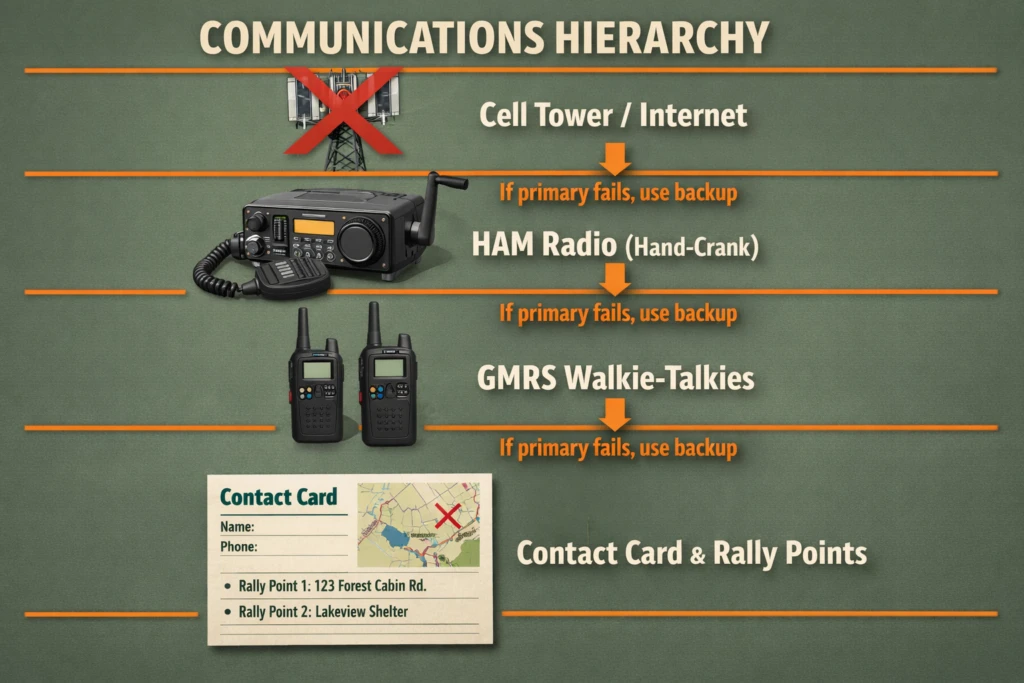 The technology stack for a prepper’s Emergency Communication Plan should be layered by range, infrastructure dependency, and skill requirement. No single technology covers all scenarios.
| Technology | Range | Infrastructure Needed | License Required | Best Use Case |
|---|---|---|---|---|
| Cell phone / SMS | Regional/national | Cell towers, power grid | No | First-attempt contact, early-stage events |
| Landline telephone | Regional | Phone lines, some power | No | Backup when cell is saturated |
| FRS walkie-talkie | 0.5–2 miles | None | No | Short-range family/neighborhood |
| GMRS radio | 1–25 miles | None (repeater optional) | Yes (FCC, USA) | Extended neighborhood/group comms |
| HAM radio (VHF/UHF) | 5–50+ miles | None (or repeater) | Yes (Technician+) | Regional coordination, emergency nets |
| HAM radio (HF) | Regional to global | None | Yes (General+) | Long-range, grid-down scenarios |
| Satellite communicator (e.g., Garmin inReach) | Global | Satellite network | No (subscription) | Remote location check-ins, SOS |
| Mesh radio networks (e.g., Meshtastic) | Variable | None | No (LoRa-based) | Off-grid local mesh networking |
Choose FRS radios if your group is primarily operating within a neighborhood and budget is a constraint. They require no license and are widely available.
Choose GMRS if your group spans several miles and you want more power and the option to use repeaters for extended range. The FCC GMRS license covers an entire family for 10 years at a modest fee.
Choose HAM radio if you are serious about long-term preparedness. A Technician-class license opens VHF/UHF communication, and a General-class license opens HF bands for regional and global reach. The licensing process is straightforward, and the exam is not prohibitively difficult.
Common mistake: Buying radios without establishing shared channel plans. Every member of the group must program identical channels, privacy codes (CTCSS tones), and know which channel is primary versus backup.
How Do You Build Rally Points Into Your Emergency Communication Plan?
Rally points are the physical backbone of an Emergency Communication Plan when all electronic communication fails. They answer the question: “Where do we go if we can’t reach each other?”
Criteria for a Good Rally Point
- Known to all group members without needing a GPS or phone to locate it.
- Accessible by multiple routes in case primary roads are blocked.
- Provides shelter or is near shelter if the group must wait.
- Has a clear, unambiguous landmark (a specific building, intersection, or geographic feature — not “the big tree near the park”).
Rally Point Protocol
- Establish the primary rally point within 1 mile of home.
- Establish a secondary rally point 10–30 miles away (outside likely disaster radius).
- Establish a tertiary rally point if your group has a dedicated bug-out location.
- Assign a “wait time”: how long will members wait at a rally point before moving to the next one? A common standard is 2 hours per check interval.
- Leave a written note (in a pre-agreed location, such as inside a specific window or under a specific rock) if you must leave before others arrive.
Edge case: If children are at school during a disaster, the school’s reunification protocol becomes part of your rally point plan. Know the school’s emergency reunification site before a crisis — it is almost never the school building itself.
What Radio Protocols and Procedures Should Your Group Know?
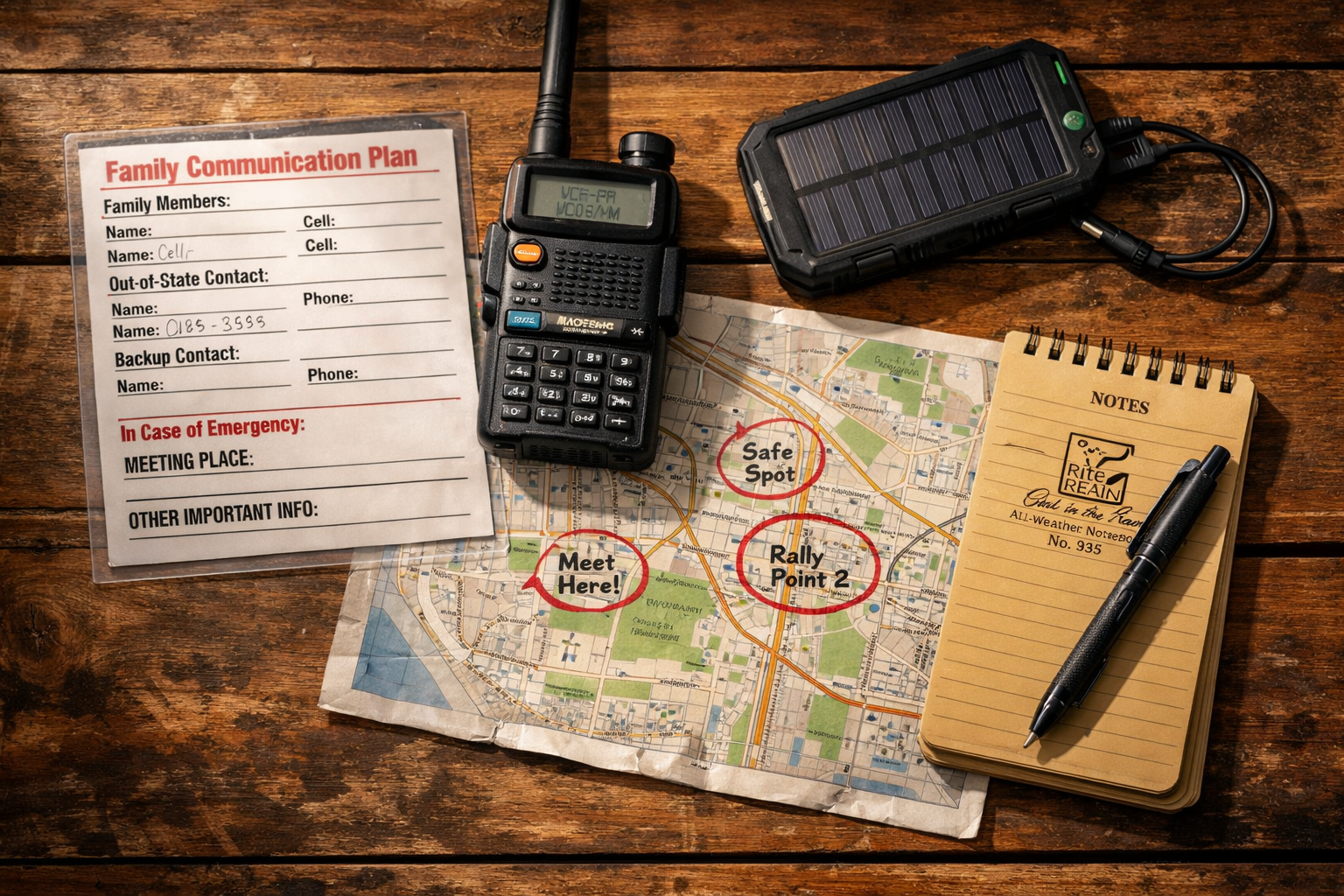
Radio discipline separates functional emergency communication from chaos. When multiple people transmit simultaneously, no one receives useful information.
Basic Radio Protocol for Preppers
- Listen before transmitting: Always monitor the channel for at least 10 seconds before keying up.
- Identify yourself: Use a callsign (required for licensed HAM operation) or a pre-agreed group handle.
- Keep transmissions short: State your message, location, and status concisely. Long transmissions waste battery and block the channel.
- Use phonetic alphabet for critical information: Alpha, Bravo, Charlie — especially for addresses, names, and codes.
- Acknowledge receipt: Confirm you received a message. “Copy” or “Roger” prevents the sender from unnecessarily repeating.
- Establish a primary and alternate channel: If the primary channel is congested or compromised, the group moves to the pre-agreed alternate.
OPSEC Considerations
In a prolonged grid-down scenario, radio transmissions are audible to anyone with a receiver on that frequency. Avoid broadcasting:
- Your exact location or address
- The size of your group
- Your resource inventory
- Your planned movements
Use pre-agreed code words for sensitive information, or use directional messaging (arrange a face-to-face meeting rather than broadcasting details).
How Do You Create an Emergency Communication Plan for Families With Children?
Children require a simplified but complete version of the Emergency Communication Plan. The goal is to give them enough information to act independently if separated from adults, without overwhelming them with complexity.
For Children Ages 6–12
- Memorize one phone number: The out-of-area contact’s number. Drill this until it is automatic.
- Know the primary rally point: Practice walking or describing the route.
- Carry a laminated card: Include the out-of-area contact number, a trusted neighbor’s name, and the primary rally point address.
- Identify two trusted adults at school and in the neighborhood who are part of the plan.
For Teenagers
Teenagers can handle the full plan and should be treated as capable group members. Assign them a specific role: monitoring a radio channel, maintaining the communication log, or managing the check-in schedule.
For Elderly or Mobility-Limited Members
- Assign a dedicated “communication buddy” who checks on them first.
- Ensure their laminated card includes medical information relevant to emergency responders.
- Pre-program radios and phones with large-button interfaces or simplified menus if needed.
How Often Should You Test and Update Your Emergency Communication Plan?
A plan that is never tested is a hypothesis, not a plan. Testing reveals gaps that paper planning cannot anticipate — dead radio batteries, forgotten channel settings, rally points that are now inaccessible, or family members who have moved.
Recommended Testing Schedule
- Monthly: Verify all radios are charged and programmed correctly. Confirm out-of-area contact information is current.
- Quarterly: Conduct a full communication drill. Simulate a scenario (e.g., “cell phones are down, attempt contact via radio and meet at rally point 1”). Debrief afterward.
- Annually: Full plan review. Update contact lists, re-evaluate technology, confirm all members know their roles, and update laminated cards if anything has changed.
Common mistake: Skipping the debrief. The drill itself is less valuable than the conversation afterward. Ask every participant: “What confused you? What didn’t work? What would you do differently?”
What Are the Most Common Mistakes in Emergency Communication Planning?
Even experienced preppers make predictable errors when building their Emergency Communication Plan. Knowing these in advance prevents them.
- Single-channel dependency: Relying on one radio frequency or one technology without a backup.
- No written records: Storing all contact information digitally on devices that lose power.
- Untested rally points: Designating a location without physically visiting it or confirming it is accessible.
- Ignoring the out-of-area contact strategy: Assuming local communication will work when regional disasters consistently prove otherwise.
- Radios with incompatible programming: Group members with radios set to different channels, tones, or bands who discover the incompatibility during an actual emergency.
- No communication schedule: Leaving radios on continuously drains batteries; having no schedule means members don’t know when to listen.
- Forgetting OPSEC: Broadcasting sensitive information on open channels.
- Excluding non-tech-savvy members: Building a plan that only works if everyone is comfortable with radio operation, when some members may need simpler protocols.
FAQ: Emergency Communication Plan
Q: What is the single most important element of an Emergency Communication Plan?
A: The out-of-area contact person. During regional disasters, local communication infrastructure saturates while long-distance calls often still connect. All group members checking in with one remote contact — who relays status to others — is the most reliable single coordination mechanism available without specialized equipment.
Q: Do I need a HAM radio license to use a HAM radio in an emergency?
A: In the United States, FCC rules include a provision allowing unlicensed individuals to use any available means of communication during a life-threatening emergency. However, operating without a license during non-emergency situations is illegal, and more importantly, untrained operators are often ineffective. Getting licensed before a crisis is strongly recommended.
Q: What is the difference between FRS and GMRS radios?
A: FRS (Family Radio Service) radios require no license, are limited to 2 watts of power, and have fixed antennas. GMRS (General Mobile Radio Service) radios require an FCC license (in the USA), allow up to 50 watts, support external antennas, and can use repeaters for extended range. For serious preparedness, GMRS is the better choice.
Q: How do I set up a communication plan if my family members are spread across multiple cities?
A: Use the out-of-area contact strategy as the coordination hub. Each family cluster (city A, city B) has its own local plan and rally points. All clusters check in with the same out-of-area contact at pre-agreed times. The contact maintains a status board and relays information between clusters.
Q: What is a Meshtastic device, and is it useful for preppers?
A: Meshtastic is an open-source project that uses LoRa radio modules to create encrypted, off-grid mesh networks for text messaging. Devices relay messages through the network, extending range without any infrastructure. As of 2026, it is a growing option for prepper groups wanting encrypted local communication without HAM licensing requirements.
Q: How do I handle communication OPSEC on the radio?
A: Pre-agree on code words for sensitive information (locations, resources, group size). Use directional messaging — arrange face-to-face meetings rather than broadcasting details. On licensed HAM frequencies, identify with your callsign but keep sensitive content minimal.
Q: Should children memorize the entire Emergency Communication Plan?
A: No. Children should memorize one phone number (the out-of-area contact), know the primary rally point, and carry a laminated card. Overloading children with complex protocols reduces reliability. Simplicity and repetition are more effective than comprehensiveness.
Q: What is the best way to store my Emergency Communication Plan?
A: In three formats simultaneously: a laminated wallet card for each member, a printed binder at home in a waterproof bag, and a digital backup on a USB drive stored in a Faraday bag. Never rely on a single storage format.
Q: How far can GMRS radios communicate?
A: Line-of-sight GMRS communication typically ranges from 1–5 miles in urban environments and up to 25 miles in open terrain. With a GMRS repeater, range can extend significantly — sometimes 50+ miles depending on repeater placement and terrain.
Q: Is a satellite communicator worth the subscription cost for preppers?
A: For individuals who travel to remote areas or who want a global SOS capability regardless of all other infrastructure, yes. Devices like the Garmin inReach provide two-way text messaging and SOS via satellite. The subscription cost is modest relative to the capability it provides as a last-resort communication layer.
Conclusion: Build the Plan, Then Practice It Until It’s Automatic
An Emergency Communication Plan is not a document — it is a practiced capability. The most technically sophisticated radio setup and the most detailed contact list are worthless if group members haven’t rehearsed using them under simulated stress.
Actionable next steps for 2026:
- This week: Designate an out-of-area contact and confirm they agree to the role. Write down their number and give it to every family member.
- This month: Purchase and program a set of GMRS or FRS radios for your immediate group. Establish a primary and backup channel. Create laminated reference cards.
- Next 90 days: Identify and physically visit two rally points. Conduct your first communication drill. Debrief and fix what breaks.
- Within six months: Begin the HAM radio licensing process if you haven’t already. The Technician-class exam is accessible with 2–4 weeks of study and opens a substantial range of emergency communication capabilities.
- Ongoing: Review and update the plan annually. Run quarterly drills. Treat communication readiness the same way you treat food and water storage — as a non-negotiable foundation of preparedness.
The groups that communicate effectively during a crisis are not the ones with the most expensive equipment. They are the ones who planned early, practiced often, and built redundancy into every layer of their system.
References
- Federal Communications Commission. (2006). Report on the August 29, 2005 Hurricane Katrina Disruption of Communications. FCC. https://www.fcc.gov/document/hurricane-katrina-impact-communications-infrastructure
- American Red Cross. (2023). Emergency Preparedness: Make a Plan. https://www.redcross.org/get-help/how-to-prepare-for-emergencies/make-a-communications-plan.html
- Federal Emergency Management Agency (FEMA). (2021). Emergency Communications Plan Guide. https://www.ready.gov/plan
- American Radio Relay League (ARRL). (2022). Amateur Radio Emergency Communications. https://www.arrl.org/emergency-communications-training
- Federal Communications Commission. (2023). General Mobile Radio Service (GMRS). https://www.fcc.gov/consumers/guides/general-mobile-radio-service-gmrs